Note D01 Revision 1 Terms read 17 October 2026
Fifty spins with the multiple struck out, and the one clock that survives the deletion
Deleting a forty times clause from an expected £4.80 deletes £192.00 of staking, 1,920 presses and 6 h 24 min of thumb work, which comes to eighteen occasions at the twenty-two minutes this note reckons a sitting to be. Ten minutes of play is what the deletion leaves standing, inside a window printed in days, and that window is the line doing the taking.
Expected off the spins £4.80 Pressing struck out 6 h 24 min Play left standing 10 min
What a credit without a multiple asks in days
Advertising has been bought for every destination below. A fee reaches this site when a reader goes on to register, and no figure on this page moves one way or the other because of it.
-
01Mobile Free Spins
Betportal
Ceiling as a multiple
What lands€15.00150 spins at 10c, which is this site's figure and not the operator'sThe run17 h 30 minTurning over 525.00 at 10p means 5,250 presses, or about 48 phone sittings of 22 minutes. Timed at 10p a press and 12 seconds between presses, both of which this site assumes rather than measures.The wait to be paidNOT PUBLISHEDThis operator puts no withdrawal band in its own terms, so there is nothing honest to print here.Spins valued at this site's own 10p a spin
What lands
Spins, at a price15.00150 of them at 10c apiece, a figure belonging to this site rather than to the operatorMatch, and other creditno figure300% of three deposits, to a ceiling of €1,000. Not a sum until money of yours makes it one, so this row totals nothing and carries nothing downwardsThe run
Handed back on the spins(0.60)Each press stakes its own value and returns 96 per cent, which leaves this much with the house from the opening pressPlay-through 35x on the bonus(20.16)Taking 14.40 round 35 times over means 504.00 through the machines, of which 20.16 is the expected cost, and 17 h 30 min of pressing at the pace aboveWhat counts towards it100%Slots only, with no percentage published anywhere, so the row above assumes the whole of each stake countsWhat never clears
Limit on the winningsstated5x the bonusDeducted on the way outno figureNothing is published as a figure here, so this row removes nothingLeast that can leaveno figureNo figure is published, so nothing on this timer is pinned down by oneLeast deposit, and the rung over ityour own€20 a stage. Published in euros, so no rung is named at all: this site's ladder is a sterling oneThe window on the creditstated14 daysBiggest stake while it runsstated€5Removed outright by rulestatedNot publishedVerified before a payoutstatedDocuments before the first withdrawalNever clears€15.00Not a penny of it gets out, so the whole of what landed stands on this rowNo Great Britain licence
Licence held in Anjouan, Comoros, the company named is BetPortal Gaming Ltd, with Excite Ultra Media Ltd, quoted under ALSI-202601040-FI2.
Terms read 17 October 2026
Open the offer at Betportal, opens in a new window -
02Mobile Free Spins
WinBeast
Ceiling as a sum
What lands€50.00500 spins at 10c, which is this site's figure and not the operator'sThe run2 d 18 hTurning over 2,000.00 at 10p means 20,000 presses, or about 182 phone sittings of 22 minutes. Timed at 10p a press and 12 seconds between presses, both of which this site assumes rather than measures.The wait to be paidNOT PUBLISHEDThis operator puts no withdrawal band in its own terms, so there is nothing honest to print here.Spins valued at this site's own 10p a spin
What lands
Spins, at a price50.00500 of them at 10c apiece, a figure belonging to this site rather than to the operatorMatch, and other creditno figure50% to 100% of five deposits, each to a ceiling of €1,000, and a €650 free bet. Not a sum until money of yours makes it one, so this row totals nothing and carries nothing downwardsThe run
Handed back on the spins(2.00)Each press stakes its own value and returns 96 per cent, which leaves this much with the house from the opening pressPlay-through 40x on the bonus and the winnings from the spins(76.80)Taking 48.00 round 40 times over means 1,920.00 through the machines, of which 76.80 is the expected cost, and 2 d 18 h of pressing at the pace aboveWhat counts towards it100%Slots, titles vary by country, with no percentage published anywhere, so the row above assumes the whole of each stake countsWhat never clears
Limit on the winningsstated€100 a batch of spinsDeducted on the way outno figureNothing is published as a figure here, so this row removes nothingLeast that can leaveno figureNo figure is published, so nothing on this timer is pinned down by oneLeast deposit, and the rung over ityour own€20 a stage. Published in euros, so no rung is named at all: this site's ladder is a sterling oneThe window on the creditstated7 days, spins 1 dayBiggest stake while it runsstatedNot publishedRemoved outright by rulestatedNot publishedVerified before a payoutstatedDocuments before the first withdrawalNever clears€50.00Not a penny of it gets out, so the whole of what landed stands on this rowNo Great Britain licence
Licence held in Curaçao, no company named anywhere on the site.
Terms read 17 October 2026
Open the offer at WinBeast, opens in a new window -
03Mobile Free Spins
EliteSpin
Longest spin window
What lands£50.00500 spins at 10p, which is this site's figure and not the operator'sThe run2 d 18 hTurning over 2,000.00 at 10p means 20,000 presses, or about 182 phone sittings of 22 minutes. Timed at 10p a press and 12 seconds between presses, both of which this site assumes rather than measures.The wait to be paidNOT PUBLISHEDThis operator puts no withdrawal band in its own terms, so there is nothing honest to print here.Spins valued at this site's own 10p a spin
What lands
Spins, at a price50.00500 of them at 10p apiece, a figure belonging to this site rather than to the operatorMatch, and other creditno figure50% to 100% of five deposits, each to a ceiling of £1,000. Not a sum until money of yours makes it one, so this row totals nothing and carries nothing downwardsThe run
Handed back on the spins(2.00)Each press stakes its own value and returns 96 per cent, which leaves this much with the house from the opening pressPlay-through 40x on the bonus and the winnings from the spins(76.80)Taking 48.00 round 40 times over means 1,920.00 through the machines, of which 76.80 is the expected cost, and 2 d 18 h of pressing at the pace aboveWhat counts towards it100%Slots, with no percentage published anywhere, so the row above assumes the whole of each stake countsWhat never clears
Limit on the winningsstated5x the bonusDeducted on the way outno figureNothing is published as a figure here, so this row removes nothingLeast that can leaveno figureNo figure is published, so nothing on this timer is pinned down by oneLeast deposit, and the rung over ityour own£20 a stage. It lands square on the £20.00 rung, so none of yours is left perched on topThe window on the creditstated7 days, spins 3 daysBiggest stake while it runsstatedNot publishedRemoved outright by rulestatedNot publishedVerified before a payoutstatedDocuments before the first withdrawalNever clears£50.00Not a penny of it gets out, so the whole of what landed stands on this rowNo Great Britain licence
Licence held in Costa Rica, the company named is PrimeTier Limited.
Terms read 17 October 2026
Open the offer at EliteSpin, opens in a new window -
04Mobile Free Spins
Crown Jewelz
Multiple unpublished
What lands£15.00150 spins at 10p, which is this site's figure and not the operator'sThe runNOT TIMEDThis operator does not publish the play-through multiple in its own terms. The multiple is the one figure the clock cannot work around, so the run is left untimed.The wait to be paidNOT PUBLISHEDThis operator puts no withdrawal band in its own terms, so there is nothing honest to print here.Nothing reckoned
What lands
Spins, at a price15.00150 of them at 10p apiece, a figure belonging to this site rather than to the operatorMatch, and other creditno figure200% of the first deposit, then 150% twice, each to a ceiling of £1,000. Not a sum until money of yours makes it one, so this row totals nothing and carries nothing downwardsThe run
Play-throughno figure40x the bonus, reported rather than published by the operatorWhat counts towards itno figureSlots, with no percentage published anywhere, so the row above assumes the whole of each stake countsWhat never clears
Limit on the winningsstatedNot publishedDeducted on the way outno figureNothing is published as a figure here, so this row removes nothingLeast that can leaveno figureNo figure is published, so nothing on this timer is pinned down by oneLeast deposit, and the rung over ityour own£20. It lands square on the £20.00 rung, so none of yours is left perched on topThe window on the creditstatedNot publishedBiggest stake while it runsstatedNot publishedRemoved outright by rulestatedNot publishedVerified before a payoutstatedDocuments before the first withdrawalNever clearsNOT RECKONEDThis operator leaves the play-through multiple out of its own terms, so nothing below the fourth step can be worked out.No Great Britain licence
Licence held in Curaçao, number not verified, no company named anywhere on the site.
Terms read 17 October 2026
Open the offer at Crown Jewelz, opens in a new window
Only the middle reading comes out of arithmetic belonging to this site. The multiple laid against what lands gives the turnover asked for; dividing that by 10p a spin gives the presses; dividing those by 300 an hour gives the hours, a press on a handset being taken here at 12 seconds from the one before. Both figures are assumptions rather than measurements of anybody: nothing was played and nothing was held a stopwatch to. Anybody quicker should divide the press count by a rate of their own, which is why the presses are printed alongside the hours instead of being summarised away.
The first reading is what arrives before any condition is laid against it. Spins carry no unit of their own so one gets supplied: where an operator values its own spin that figure is used and attributed, and where it does not, this site's 10p a spin stands in and everything below moves with it. The third reading belongs to the operator entirely. It is a withdrawal band quoted from published terms, and a blank there means none was published rather than that nobody looked.
The total along the foot answers what the hours leave open, which is whether any of the running ends anywhere. It is what arrived, less whatever is still standing once the play-through has been paid for at 96 per cent return to player and once a published limit, a published deduction and a published floor beneath the least that can leave have each had a turn. It appears again in pence in the pound, the only fair way of holding a small offer up against a large one. It describes an offer rather than an evening, and where the conditions price out what arrived, a timer prints nothing getting out instead of a negative sum.
Cashiers on a handset take deposits off a row of preset buttons, so a least deposit given in pounds is raised to the next rung of the ladder used here, £10, £20, £25, £50, £75 and £100, and the timer shows what is left perched on it. That money is the reader's own and enters no sum at all. Given in euros it prints untouched, the ladder being sterling. Three words may occupy the figure column where no figure belongs. Stated is a published term that costs something while leaving no number to subtract. No figure is a term nobody has quantified, or a credit that is not a sum until money of yours makes it one. Your own is money of yours, which belongs in none of this.
None of the operators above is licensed in Great Britain, so not one duty that licence carries reaches any of them. Membership of Gamstop Online is compulsory for every online gambling company licensed in Great Britain, which means that shutting yourself out through the scheme shuts you out of none of these. The limit of ten times the bonus funds on a wagering requirement, running since 19 January 2026 under Social Responsibility Code 5.1.1, is a condition of the same licence and binds only whoever holds one. Off that licence, the Gambling Commission writes of consumers meeting unfair gaming practices, financial loss and no recourse when matters go wrong, and lists blocked payouts and withdrawal limits pitched too high to reach among the things it has seen. No account at any of them may be held by anybody under 18.
Every term on a timer is its operator's own and every timer carries the day somebody read it. The oldest of those readings is 17 October 2026. What binds a reader is an operator's full terms and never a line printed here.
1
Two quantities vanish when a multiple does
Two things leave an arrangement when the words no wager get attached to it, and only one of the pair is money. A multiple leaves, which is the half everybody notices. Hours leave with it, and that half goes unremarked, because nobody prints hours beside a credit in the first place.
Four pounds eighty is what fifty presses at ten pence are expected to hand back where ninety-six pence in the pound comes home, that percentage being the working return this site applies to any reel it has not been given a published figure for. Five pounds crosses the reels. Twenty pence is expected to stay behind. So the credit standing in the account before any condition touches it is £4.80.
One hundred and ninety-two pounds of staking is the figure a forty times clause would have fastened to that £4.80, and the sum deserves writing out rather than describing. Forty lots of £4.80 make £192.00 of staking. Divided into ten pence pieces that is 1,920 presses. At twelve seconds for one press, an interval this note reckons and has not measured, the whole comes to 23,040 seconds, 384 minutes, 6 h 24 min of thumb.
Eighteen separate occasions sit behind that total, a sitting being reckoned here at twenty-two minutes and 110 presses, which is this note’s convention rather than anything anybody watched. Dividing 1,920 by 110 returns 17.45, and nobody attends forty-five per cent of an occasion, so the figure carries upward to eighteen.
Ten minutes is the other reading of the same fifty spins, and it is the one that survives. Fifty presses at the reckoned twelve seconds occupy 600 seconds. Set 600 seconds against 23,040 and the arrangement with the clause attached is 38.4 times longer than the arrangement without it, which is the honest size of what the phrase no wager deletes.
6 h 24 min deleted, 10 min left behind, a ratio of 38.4 to one
Thirty-eight and a half times over is a strange thing to be given for nothing, and it is not given for nothing. What replaces the multiple is a date, and a date is cheaper to administer and quieter to print. The remaining eight parts price the date the same way the clause has just been priced.
2
Six hours and twenty-four minutes, costed before deletion
A sum nobody has to pay is still worth costing, because the size of it explains why the phrase sells. Three separate costs attach to a forty times clause on a credit of £4.80, and they are a quantity of staking, a quantity of attention, and a quantity of expected money. All three go when the clause goes.
Staking first. £192.00 across the reels is nineteen hundred and twenty presses, and nineteen hundred and twenty presses is more than the credit itself can fund thirty-eight times over. The credit funds forty-eight presses, being £4.80 at ten pence. Each of the remaining 1,872 presses is funded by whatever the previous ones returned, which is the mechanism that makes a play-through look survivable while the average walks downhill.
Attention second. Six hours and twenty-four minutes is a working day with a lunch break, performed on a handset, in exchange for a credit of less than five pounds. Spread at one reckoned occasion an evening, the clause fills eighteen evenings, a fortnight and four nights of pressing, before anybody may ask for anything.
Expected money third, and this is where the arithmetic turns unpleasant. Four hundredths of all staking is the house’s share where ninety-six per cent comes back, that percentage being this note’s working figure. £192.00 of staking therefore sheds £7.68 of expected margin. Set that against a credit of £4.80 and the clause expects to consume the credit and £2.88 besides.
£7.68 of expected margin asked of a £4.80 credit
Minus two pounds eighty-eight is what the house formula returns for the same input, and the two routes agreeing is the check worth making. Forty multiplied by four hundredths is 1.6. One less 1.6 is minus 0.6. Four pounds eighty taken through that factor gives minus £2.88, which is the figure the subtraction reached from the other direction.
Nothing in that paragraph depends on the window, the lobby, the title or the day of the week. It depends on the multiple, the return and the size of the credit, and those three fix the answer before anybody opens anything. Which is why deleting the multiple is a genuine deletion and not a rearrangement.
3
Where each multiple would have left the money
Five rungs are worth laying side by side, because a reader meeting the phrase no wager is being offered the top rung and has no way of knowing what the others cost. The rungs are nought, ten, twenty-five, forty and sixty times, and each is applied to the same expected £4.80.
Twenty-five is the rung that matters mathematically and it is not a market figure. At a ninety-six per cent return the house keeps four hundredths of everything staked, so twenty-five passes of the credit shed exactly the credit. Any multiple beneath twenty-five is expected to leave something. Any multiple above it is expected to leave a deficit, and forty is above it by fifteen.
| The multiple | Presses | Occasions | Staking it wants | Thumb time reckoned | Expected at the close |
|---|---|---|---|---|---|
| None at all | 0 | 0 | £0.00 | 0 min | £4.80 |
| Ten times | 480 | 5 | £48.00 | 1 h 36 min | £2.88 |
| Twenty-five times | 1,200 | 11 | £120.00 | 4 h | £0.00 |
| Forty times | 1,920 | 18 | £192.00 | 6 h 24 min | minus £2.88 |
| Sixty times | 2,880 | 27 | £288.00 | 9 h 36 min | minus £6.72 |
Column five is the column this site exists to print. Ninety-six minutes at ten times, four hours at twenty-five, 6 h 24 min at forty and 9 h 36 min at sixty, all of them reckoned at twelve seconds for one press and none of them observed. A reader comparing multiples is comparing those durations whether or not anybody has shown them.
Nine hours and thirty-six minutes in the bottom row is the shape of the market the British ceiling was written against, since the regulator itself put current practice as high as sixty times when it set a limit at ten. Between the second row and the last row lie 2,400 presses, eight hours of thumb and £9.60 of expected position, and the whole difference is one number in one sentence of a terms page.
Nought in the top row is the row this page is about, and it is genuinely the best row. The caution is that the top row is not the end of the sheet. A credit with no multiple over it has a date over it instead, and part four begins counting that.
A multiple and a date are not alternatives a reader gets to choose between. They are two separate clauses, and an arrangement carrying neither does not exist. Where the multiple is struck out the date does all the work, which raises its importance rather than lowering it, and it is printed in smaller type than the multiple ever was.
4
Ten minutes of play, and the days allotted to it
Ten minutes is the whole of the play. Fifty presses at a reckoned twelve seconds apiece occupy 600 seconds, which is less than half of one occasion at the twenty-two minutes this note allots to a sitting. A reader who opens the lobby once, presses fifty times and closes it has finished everything the arrangement contains.
Seven days is the window this note adopts for the arithmetic below, stated plainly as an adopted figure rather than a published one, because no British rule names a length for an expiry on a credit and a length nobody publishes is not a length to invent. Every day figure in the next three parts rests on that seven and on nothing firmer.
Ten thousand and eighty minutes is seven days expressed in the unit the play is expressed in, being 168 hours at sixty minutes each. Ten minutes of play inside 10,080 minutes of window is one part in 1,008. The window is therefore a thousand times longer than the thing it governs, and that ratio is the first odd fact about a credit built this way.
| What is being measured | In minutes | Share of the week |
|---|---|---|
| Fifty presses at the reckoned interval | 10 | 0.10% |
| One occasion as this note reckons it | 22 | 0.22% |
| The deleted clause, end to end | 384 | 3.81% |
| The window this note adopts | 10,080 | 100% |
Row three is the row that makes the point. Even the clause this arrangement does not carry would have occupied under four per cent of a seven day window, measured purely as thumb time. A window is not short because the pressing is long. A window is short because of when a person is awake, employed, travelling or asleep, and none of those appear in a terms page.
Nought point one per cent is the share the play itself takes, and a reader who misses the window has not missed it by failing to find ten minutes. They have missed it by failing to remember a date, which is a different kind of failure and the one every expiry clause is built to harvest.
5
A minute and twenty-six seconds a day is the entire ask
Eighty-five point seven seconds is the daily requirement, and writing it down is the clearest demonstration available of how little work an arrangement of this build asks for. Six hundred seconds of play spread evenly across seven days gives 85.71 seconds a day, which rounds to one minute and twenty-six seconds.
Seven point one four presses is the same requirement counted the way this site counts everything. Fifty presses over seven days is 7.14 a day, so a reader pressing eight times each morning finishes the arrangement with a day to spare and has spent under ten minutes in total doing it.
Four pounds eighty is still the expected return at the end of that, because expectation is settled by the stake, the count and the percentage returning, and not by the timetable. Spreading the fifty presses over a week does not reduce the expected £4.80 and concentrating them in one morning does not raise it. Only the forfeit moves, and it moves in one direction.
7.14 presses a day, 85.7 seconds, against a 10,080 minute window
Sixty-eight point six pence is what one day of that window is worth if the expected £4.80 is divided across it evenly, and the division is worth doing once because it converts a date into a price. A reader who lets a day go past has not lost sixty-eight pence. They have lost nothing at all until the last day, and then they lose the lot, which is the peculiar shape of an expiry and the reason it is mispriced by almost everybody meeting one.
Nothing accrues and nothing decays in between. A window is a cliff rather than a slope, and the whole of the £4.80 stands at full value on the final morning and at nought on the following one. An arrangement reached through a search reading 50 free spins no deposit no wager hides that cliff behind the deletion of the multiple, because the deletion is the exciting half of the sentence and the date is the half that gets skimmed.
6
Why a struck clause and a week were never compatible
Fifty-four minutes and fifty-one seconds is the daily demand the deleted clause would have placed inside the window this note adopts, repeated for a week without one night off. Three hundred and eighty-four minutes over seven days gives 54.86, and measured against the twenty-two minute occasion reckoned here that is 2.49 pick-ups of a handset daily, carrying to three.
Two hundred and seventy-five presses a day is the same demand in presses, being 1,920 over seven and carried up from 274.3. A reader meeting both clauses at once would therefore be pressing 275 times a day for a week to satisfy a condition over a credit of £4.80, and arriving at an expected minus £2.88 for the trouble.
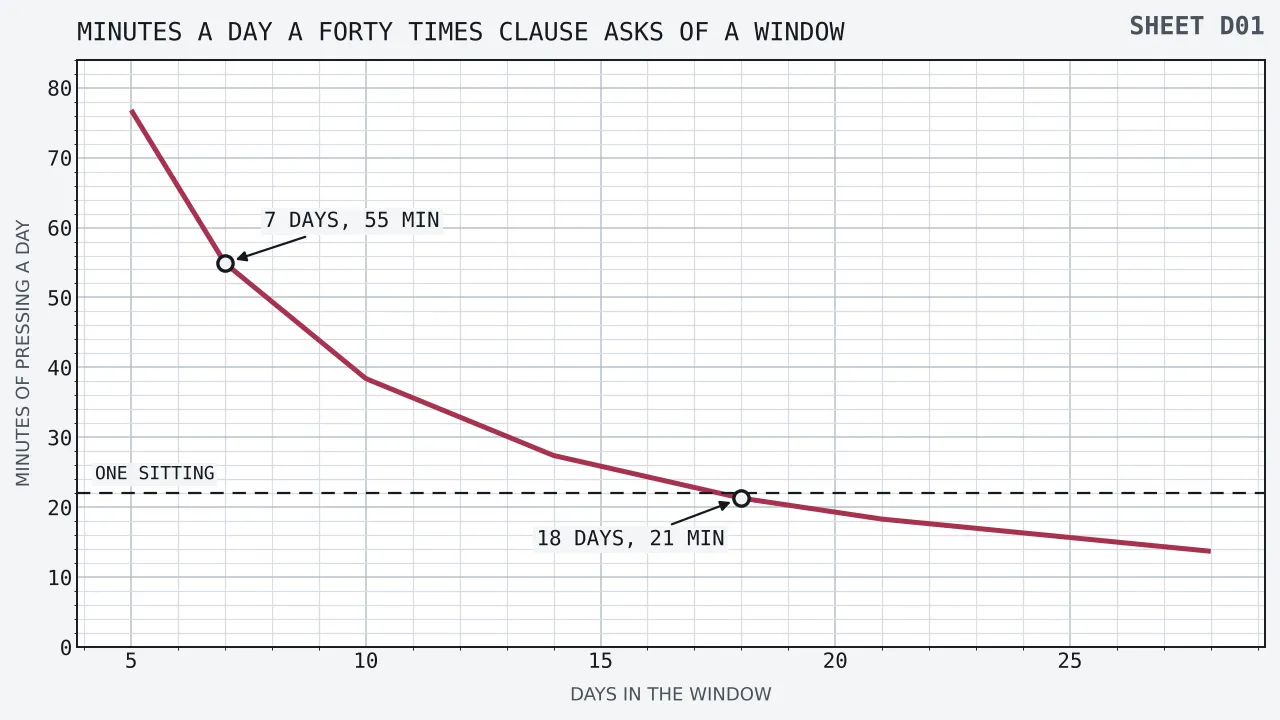
Seventeen point four five days is where the curve meets the horizontal, which is 384 minutes divided by twenty-two. Below that length of window the clause cannot be discharged on one occasion a day. An eighteen day window is the first that can, and eighteen days is longer than the week this note has adopted by eleven.
One day on the left of the figure is worth reading as well, because it is the shape of a twenty-four hour expiry, which is a length many arrangements of this family actually print. Three hundred and eighty-four minutes inside one day is six hours and twenty-four minutes of pressing between waking and sleeping, seventeen and a half occasions, and a reader doing it would be at the handset for a quarter of the day.
Nought of that happens on this arrangement, and that is the honest good news. The curve exists to show what the deletion was worth, and it was worth most on the short windows, because a short window and a long clause are the combination that strands people. Removing the clause removes the collision entirely and leaves one date to remember.
7
What the last hour of a window takes away
Three things lapse together at the end of a window on an arrangement of this build, and a reader usually has one of the three in mind. Unused spins lapse. Credit standing from used spins lapses. And any balance built on top of that credit lapses with it, because the balance inherits the status of the money that made it.
Four pounds eighty is the whole of the expected forfeit, and it is worth stating that the forfeit is larger than the headline suggests precisely because nothing was staked to earn it. A reader who deposited nothing loses nothing from their own pocket when a window closes. What they lose is the entire proceeds of the exercise, which is the only thing the exercise was for.
| What is standing | Expected value | What the date does to it |
|---|---|---|
| Fifty spins, none pressed | £4.80 | Gone whole, with ten minutes of play unused |
| Twenty-five spins pressed | £2.40 | Half the proceeds and half the play together |
| All fifty pressed, nothing asked for | £4.80 | Gone whole, with the play already spent |
| A payment of the reader’s own | Nil here | Nothing, since none was ever made |
Row three is the cruel one and it is the commonest. A reader presses fifty times on a Tuesday, sees a balance, intends to deal with it at the weekend, and meets a date that fell on the Friday. Ten minutes of play has been spent, the proceeds have been generated, and the whole of the £4.80 goes because a request was not made in time.
Ninety-six pence is what the same forfeit looks like on each of the five working days of a week, if a reader insists on thinking of it as something that drains gradually, and it does not drain gradually. The value is intact at 23:59 on the final day and absent at 00:01, and no partial credit exists for having pressed the spins.
One further date usually sits behind the one a reader is watching, and its subject is the account instead of the credit. Dormancy clauses, inactivity charges and closure terms run on their own schedules and are written in a different part of the sheet entirely. Where the credit expires in days the account may still be running in months, and the two are not the same clock.
8
Terms nobody is obliged to keep within reach
No Great Britain licence sits underneath an arrangement assembled this way. Where the subject is a deleted clause and a surviving date, the losses worth naming are those governing an incentive’s own wording, because once the multiple goes the wording is the only place the remaining numbers live. Other losses are real and other notes price them.
Plain, honest and even-handed is the substance of what a British licence demands of whatever conditions ride on an incentive, together with a duty to put those conditions somewhere every person they are offered to is able to find them. The code provision doing that work runs across operating licences generally, the technical and software kinds excepted, and its page names no date on which it started. On a credit whose one surviving number is a date, that is the duty that would have mattered.
Ten minutes of play against a reachability duty is the comparison worth making. A reader needs under a minute to read an expiry length and under ten minutes to use the credit, so the entire protection consists of a sentence being somewhere findable. Where no licence attaches, whether that sentence is findable is a matter of house style.
| The number | Fixed by a British rule | Fixed by nobody | What it is worth here |
|---|---|---|---|
| The ceiling on a multiple | Ten times the bonus funds | 4 h 48 min of difference | |
| What one spin is worth in pence | A commercial choice, unpublished | £5.00 of staking at 10p | |
| Whether a spin is itself bonus funds | Not stated either way | Decides if the ceiling bites | |
| The length of an expiry window | No published length at all | The whole of the £4.80 |
Four hours and forty-eight minutes in row one is the arithmetic of the ceiling against this credit. Ten times £4.80 is £48.00 of staking, 480 presses and 1 h 36 min on the reckoned interval, against the 6 h 24 min that forty times wanted. A licence is therefore worth 1,440 presses on this one arrangement, and none of them are asked for here because the multiple has already gone.
Rows two and three are the honest gaps and they are gaps in what anybody has published, not gaps in what is known. No British rule puts a price on one spin, and the question of whether a spin’s winnings count as bonus funds, which is what settles whether the ten times ceiling reaches them at all, has been left alone in both directions. A page that filled either gap would be inventing the two numbers an arrangement of this kind turns on.
Two sentences is the whole of what the offshore rulebook read for this network says about incentives: that bonuses and promotions be communicated transparently with clear terms, and that aggressive bonus promotion must not encourage excessive gambling. Against that, row four is unguarded on both sides of the register, and the date is whatever the sheet says it is.
9
Who a credit of this build genuinely suits
Ten minutes, one date and no staking obligation is a genuinely decent proposition measured against the alternatives, and a page that grudged saying so would be useless. A reader who wants to see a lobby work on their handset, press fifty times and find out whether the sign-up and the payout machinery behave has a cheap and quick way of doing it here.
Eighteen occasions is the thing not being asked for, and the comparison is the whole argument. Against the same credit under a forty times clause, this arrangement saves 1,920 presses, 6 h 24 min of thumb and £7.68 of expected margin, and it converts an expected minus £2.88 into an expected £4.80. No other change available on a terms page moves a figure that far.
One date is the price, and the price is only ever paid by forgetting. Nothing about the arrangement requires skill, speed or persistence. It requires a reader to press fifty times and ask for the proceeds inside the window, and the entire expected £4.80 turns on whether the second half of that sentence happens.
Three numbers are worth finding before starting, and none of them is the count of spins. How many days the credit lives, measured from when it is credited rather than from when it is claimed. Whether the proceeds carry a separate and shorter date of their own. And what the smallest sum the cashier will move actually is, since an expected £4.80 is beneath a great many of them.
Nobody should treat this as a reason to seek out arrangements of this family at volume. Four pounds eighty expected, at the cost of ten minutes and a set of identity details handed to a business the British register does not list, is a modest trade on one occasion and a poor habit repeated. The arithmetic that makes the first one reasonable is the same arithmetic that makes the tenth one a pattern.
Questions
- What does no wager actually remove from a 50 spin offer?
- A multiple, and the hours behind it. On an expected £4.80 a forty times clause wants £192.00 of staking, which at ten pence is 1,920 presses, 23,040 seconds and 6 h 24 min of thumb at the twelve seconds this note reckons for one press. That comes to eighteen occasions once the twenty-two minute sitting reckoned here is divided into it. Both intervals are conventions adopted on this site and neither was observed.
- Is there still a deadline if there is no wagering requirement?
- Yes, and it becomes the only clause that matters. The spins carry a date, and so does anything they return. This note adopts seven days for its arithmetic and says so plainly, because no British rule fixes a length for an expiry on a credit. Ten minutes of play inside a seven day window is one part in 1,008, so the window is a thousand times longer than the thing it governs.
- How much time do fifty free spins actually take?
- Six hundred seconds, which is ten minutes. Fifty presses at the twelve seconds reckoned here occupy less than half of one occasion at the twenty-two minutes this note allots to a sitting. Spread across a seven day window it comes to 7.14 presses and 85.7 seconds a day, so a reader pressing eight times each morning is finished with a day in hand.
- What are fifty free spins expected to be worth?
- Four pounds eighty. Fifty presses at ten pence amount to £5.00 of staking, the working return applied here is ninety-six per cent wherever a title has published no figure of its own, and twenty pence is expected to stay behind. That £4.80 is the whole of what a window can take away, since no payment of the reader’s own is involved.
- Would a forty times clause have been finishable in a week?
- Only by pressing 275 times a day. Three hundred and eighty-four minutes over seven days is 54 min 51 s daily, which is 2.49 pick-ups of a handset against an occasion reckoned at twenty-two minutes and carries to three. A window of eighteen days is the first that brings the clause inside one occasion a day, and that is eleven days longer than the week adopted here.
- What happens to winnings if the window closes first?
- They go whole, and nothing is kept back for part completion. Unused spins lapse, credit standing from used spins lapses, and any balance built on that credit lapses with it. A reader who pressed all fifty on the Tuesday and meant to deal with the proceeds at the weekend forfeits the entire expected £4.80 if the date fell on the Friday. The value is intact on the final day and absent on the next.
- What does a British licence add that this arrangement lacks?
- Reachable wording, mainly. Nothing of this construction carries a Great Britain licence, and the duty that would have bitten here asks that whatever conditions ride on an incentive be plain, honest and even-handed, and be put where every person they are offered to can get at them. That provision attaches to operating licences at large, leaving out only the technical and software kinds, and its page names no starting date. The pence figure attached to a spin answers to nobody, the status of a spin’s winnings against the ten times ceiling is unstated in both directions, and no length for an expiry is published anywhere, so those three numbers belong to whoever drafted the sheet.
- Is a credit with no multiple on it better than one with forty times?
- By 1,920 presses and £7.68 of expected margin, yes. The same £4.80 under a forty times clause is expected to close at minus £2.88, and under no clause at all it closes at £4.80. What replaces the multiple is a date, and the date takes the whole £4.80 from anybody who misses it, so the saving is real and the remaining risk sits entirely in a diary.