Note B08 Revision 1 Terms read 17 October 2026
5 free spins no deposit, one minute handed over against thirty-eight minutes owed
Five presses of 10p stake fifty pence and occupy 1 min at the twelve seconds a press this site assumes. The forty times clause fastened to the 48p they are expected to raise runs 38 min. This is the smallest arrangement in the market, and the one where the condition outlasts the prize whichever unit it is counted in. The consolation is real and narrow: a run that short is over in an evening, so the expiry that strands a larger pile never gets near this one.
What lands 1 min The run 38 min The wait to be paid Never reached
What offers of this size ask in hours
Advertising has been bought for every destination below. A fee reaches this site when a reader goes on to register, and no figure on this page moves one way or the other because of it.
-
01Mobile Free Spins
Betportal
Ceiling as a multiple
What lands€15.00150 spins at 10c, which is this site's figure and not the operator'sThe run17 h 30 minTurning over 525.00 at 10p means 5,250 presses, or about 48 phone sittings of 22 minutes. Timed at 10p a press and 12 seconds between presses, both of which this site assumes rather than measures.The wait to be paidNOT PUBLISHEDThis operator puts no withdrawal band in its own terms, so there is nothing honest to print here.Spins valued at this site's own 10p a spin
What lands
Spins, at a price15.00150 of them at 10c apiece, a figure belonging to this site rather than to the operatorMatch, and other creditno figure300% of three deposits, to a ceiling of €1,000. Not a sum until money of yours makes it one, so this row totals nothing and carries nothing downwardsThe run
Handed back on the spins(0.60)Each press stakes its own value and returns 96 per cent, which leaves this much with the house from the opening pressPlay-through 35x on the bonus(20.16)Taking 14.40 round 35 times over means 504.00 through the machines, of which 20.16 is the expected cost, and 17 h 30 min of pressing at the pace aboveWhat counts towards it100%Slots only, with no percentage published anywhere, so the row above assumes the whole of each stake countsWhat never clears
Limit on the winningsstated5x the bonusDeducted on the way outno figureNothing is published as a figure here, so this row removes nothingLeast that can leaveno figureNo figure is published, so nothing on this timer is pinned down by oneLeast deposit, and the rung over ityour own€20 a stage. Published in euros, so no rung is named at all: this site's ladder is a sterling oneThe window on the creditstated14 daysBiggest stake while it runsstated€5Removed outright by rulestatedNot publishedVerified before a payoutstatedDocuments before the first withdrawalNever clears€15.00Not a penny of it gets out, so the whole of what landed stands on this rowNo Great Britain licence
Licence held in Anjouan, Comoros, the company named is BetPortal Gaming Ltd, with Excite Ultra Media Ltd, quoted under ALSI-202601040-FI2.
Terms read 17 October 2026
Open the offer at Betportal, opens in a new window -
02Mobile Free Spins
WinBeast
Ceiling as a sum
What lands€50.00500 spins at 10c, which is this site's figure and not the operator'sThe run2 d 18 hTurning over 2,000.00 at 10p means 20,000 presses, or about 182 phone sittings of 22 minutes. Timed at 10p a press and 12 seconds between presses, both of which this site assumes rather than measures.The wait to be paidNOT PUBLISHEDThis operator puts no withdrawal band in its own terms, so there is nothing honest to print here.Spins valued at this site's own 10p a spin
What lands
Spins, at a price50.00500 of them at 10c apiece, a figure belonging to this site rather than to the operatorMatch, and other creditno figure50% to 100% of five deposits, each to a ceiling of €1,000, and a €650 free bet. Not a sum until money of yours makes it one, so this row totals nothing and carries nothing downwardsThe run
Handed back on the spins(2.00)Each press stakes its own value and returns 96 per cent, which leaves this much with the house from the opening pressPlay-through 40x on the bonus and the winnings from the spins(76.80)Taking 48.00 round 40 times over means 1,920.00 through the machines, of which 76.80 is the expected cost, and 2 d 18 h of pressing at the pace aboveWhat counts towards it100%Slots, titles vary by country, with no percentage published anywhere, so the row above assumes the whole of each stake countsWhat never clears
Limit on the winningsstated€100 a batch of spinsDeducted on the way outno figureNothing is published as a figure here, so this row removes nothingLeast that can leaveno figureNo figure is published, so nothing on this timer is pinned down by oneLeast deposit, and the rung over ityour own€20 a stage. Published in euros, so no rung is named at all: this site's ladder is a sterling oneThe window on the creditstated7 days, spins 1 dayBiggest stake while it runsstatedNot publishedRemoved outright by rulestatedNot publishedVerified before a payoutstatedDocuments before the first withdrawalNever clears€50.00Not a penny of it gets out, so the whole of what landed stands on this rowNo Great Britain licence
Licence held in Curaçao, no company named anywhere on the site.
Terms read 17 October 2026
Open the offer at WinBeast, opens in a new window -
03Mobile Free Spins
EliteSpin
Longest spin window
What lands£50.00500 spins at 10p, which is this site's figure and not the operator'sThe run2 d 18 hTurning over 2,000.00 at 10p means 20,000 presses, or about 182 phone sittings of 22 minutes. Timed at 10p a press and 12 seconds between presses, both of which this site assumes rather than measures.The wait to be paidNOT PUBLISHEDThis operator puts no withdrawal band in its own terms, so there is nothing honest to print here.Spins valued at this site's own 10p a spin
What lands
Spins, at a price50.00500 of them at 10p apiece, a figure belonging to this site rather than to the operatorMatch, and other creditno figure50% to 100% of five deposits, each to a ceiling of £1,000. Not a sum until money of yours makes it one, so this row totals nothing and carries nothing downwardsThe run
Handed back on the spins(2.00)Each press stakes its own value and returns 96 per cent, which leaves this much with the house from the opening pressPlay-through 40x on the bonus and the winnings from the spins(76.80)Taking 48.00 round 40 times over means 1,920.00 through the machines, of which 76.80 is the expected cost, and 2 d 18 h of pressing at the pace aboveWhat counts towards it100%Slots, with no percentage published anywhere, so the row above assumes the whole of each stake countsWhat never clears
Limit on the winningsstated5x the bonusDeducted on the way outno figureNothing is published as a figure here, so this row removes nothingLeast that can leaveno figureNo figure is published, so nothing on this timer is pinned down by oneLeast deposit, and the rung over ityour own£20 a stage. It lands square on the £20.00 rung, so none of yours is left perched on topThe window on the creditstated7 days, spins 3 daysBiggest stake while it runsstatedNot publishedRemoved outright by rulestatedNot publishedVerified before a payoutstatedDocuments before the first withdrawalNever clears£50.00Not a penny of it gets out, so the whole of what landed stands on this rowNo Great Britain licence
Licence held in Costa Rica, the company named is PrimeTier Limited.
Terms read 17 October 2026
Open the offer at EliteSpin, opens in a new window -
04Mobile Free Spins
Crown Jewelz
Multiple unpublished
What lands£15.00150 spins at 10p, which is this site's figure and not the operator'sThe runNOT TIMEDThis operator does not publish the play-through multiple in its own terms. The multiple is the one figure the clock cannot work around, so the run is left untimed.The wait to be paidNOT PUBLISHEDThis operator puts no withdrawal band in its own terms, so there is nothing honest to print here.Nothing reckoned
What lands
Spins, at a price15.00150 of them at 10p apiece, a figure belonging to this site rather than to the operatorMatch, and other creditno figure200% of the first deposit, then 150% twice, each to a ceiling of £1,000. Not a sum until money of yours makes it one, so this row totals nothing and carries nothing downwardsThe run
Play-throughno figure40x the bonus, reported rather than published by the operatorWhat counts towards itno figureSlots, with no percentage published anywhere, so the row above assumes the whole of each stake countsWhat never clears
Limit on the winningsstatedNot publishedDeducted on the way outno figureNothing is published as a figure here, so this row removes nothingLeast that can leaveno figureNo figure is published, so nothing on this timer is pinned down by oneLeast deposit, and the rung over ityour own£20. It lands square on the £20.00 rung, so none of yours is left perched on topThe window on the creditstatedNot publishedBiggest stake while it runsstatedNot publishedRemoved outright by rulestatedNot publishedVerified before a payoutstatedDocuments before the first withdrawalNever clearsNOT RECKONEDThis operator leaves the play-through multiple out of its own terms, so nothing below the fourth step can be worked out.No Great Britain licence
Licence held in Curaçao, number not verified, no company named anywhere on the site.
Terms read 17 October 2026
Open the offer at Crown Jewelz, opens in a new window
Only the middle reading comes out of arithmetic belonging to this site. The multiple laid against what lands gives the turnover asked for; dividing that by 10p a spin gives the presses; dividing those by 300 an hour gives the hours, a press on a handset being taken here at 12 seconds from the one before. Both figures are assumptions rather than measurements of anybody: nothing was played and nothing was held a stopwatch to. Anybody quicker should divide the press count by a rate of their own, which is why the presses are printed alongside the hours instead of being summarised away.
The first reading is what arrives before any condition is laid against it. Spins carry no unit of their own so one gets supplied: where an operator values its own spin that figure is used and attributed, and where it does not, this site's 10p a spin stands in and everything below moves with it. The third reading belongs to the operator entirely. It is a withdrawal band quoted from published terms, and a blank there means none was published rather than that nobody looked.
The total along the foot answers what the hours leave open, which is whether any of the running ends anywhere. It is what arrived, less whatever is still standing once the play-through has been paid for at 96 per cent return to player and once a published limit, a published deduction and a published floor beneath the least that can leave have each had a turn. It appears again in pence in the pound, the only fair way of holding a small offer up against a large one. It describes an offer rather than an evening, and where the conditions price out what arrived, a timer prints nothing getting out instead of a negative sum.
Cashiers on a handset take deposits off a row of preset buttons, so a least deposit given in pounds is raised to the next rung of the ladder used here, £10, £20, £25, £50, £75 and £100, and the timer shows what is left perched on it. That money is the reader's own and enters no sum at all. Given in euros it prints untouched, the ladder being sterling. Three words may occupy the figure column where no figure belongs. Stated is a published term that costs something while leaving no number to subtract. No figure is a term nobody has quantified, or a credit that is not a sum until money of yours makes it one. Your own is money of yours, which belongs in none of this.
None of the operators above is licensed in Great Britain, so not one duty that licence carries reaches any of them. Membership of Gamstop Online is compulsory for every online gambling company licensed in Great Britain, which means that shutting yourself out through the scheme shuts you out of none of these. The limit of ten times the bonus funds on a wagering requirement, running since 19 January 2026 under Social Responsibility Code 5.1.1, is a condition of the same licence and binds only whoever holds one. Off that licence, the Gambling Commission writes of consumers meeting unfair gaming practices, financial loss and no recourse when matters go wrong, and lists blocked payouts and withdrawal limits pitched too high to reach among the things it has seen. No account at any of them may be held by anybody under 18.
Every term on a timer is its operator's own and every timer carries the day somebody read it. The oldest of those readings is 17 October 2026. What binds a reader is an operator's full terms and never a line printed here.
1
One minute of pressing, and the 48 pence it raises
Fifty pence is the whole stake five presses send over the reels at 10p apiece, and it is the smallest sum this site has had to put a clock against. Ten pence is where a spin minted for nothing sits pegged across most of this market, and the peg belongs to whoever issues it: no control a reader can reach alters the denomination either way.
Two pence of that fifty is the margin where ninety-six come back in each hundred, so £0.48 is the credit five presses are expected to raise. Spendable on arrival it is not. Bonus funds are the form the figure takes, and a clause of forty times measures itself against 48p while leaving the fifty pence of staking underneath out of the reckoning altogether.
Sixty seconds is the handout in full, being five presses at the twelve seconds this note allows one. Held beside the twenty-two minutes it counts as a single sitting with a handset, sixty seconds comes to 4.5 per cent of one occasion with the phone. Twelve seconds is a modelling input of this site’s own choosing, arrived at by argument rather than off any clock held against a thumb.
| The line | Figure |
|---|---|
| Presses credited | 5 |
| Staked, at 10p to a press | £0.50 |
| Margin kept where 96 pence returns | £0.02 |
| Credit the five are expected to raise | £0.48 |
| Seconds used, twelve to a press | 60 |
| Which reads as | 1 min |
| Portion of one 22-minute sitting | 4.5% |
Five results is the thinnest sample any page on this site works from. The 48p is an average over all the ways five presses can fall and it anticipates no particular five: a clear majority of such runs end at nothing whatever, a small minority end at fifty or a hundred times the stake, and the average is the one quantity available before a thumb has moved.
Press number five closes everything handed over without condition. From that instant there is 48p of credit, a clause of forty times, and an expiry already counting down; the banner carried the first and said nothing of the other three. Every quantity printed below derives from three declared inputs rather than from observation: ten pence on a press, ninety-six pence returning out of each hundred staked, and a twelve-second interval charged against every press.
2
Five presses credited against 192 presses owed
Nineteen pounds and twenty pence has to cross the reels before 48p may be asked for, that being forty applied to the credit. Cut £19.20 into 10p pieces and 192 of them appear; at twelve seconds a piece those 192 fill 2,304 seconds, which is 38.4 minutes, or 38 min to the nearest whole one. Divide 38.4 by the twenty-two minutes a sitting is given here and 1.75 comes out, and a fraction of a sitting still means the phone has been picked up again, so the clause settles at two.
One hundred and ninety-two weighed against five is the exchange a reader enters, and the exchange runs one way only. Staking that satisfies the clause is drawn from the very 48p the gift created, so the gift supplies the fuel for its own consumption. None of it is hidden. What never happens is the conversion into a unit anybody would object to.
192 presses owed on a pile credited in 5
Four tenths of a penny is what one press costs the credit in expectation, being four per cent of a 10p stake. Divide 48p by 0.4p and 120 comes out: that is how many presses the credit itself can pay for before the margin has taken all of it. The clause wants 192. Seventy-two presses of the obligation, which is 14.4 minutes of pressing, stand on nothing at all.
Press 120 arrives at the twenty-fourth minute, and the twenty-fourth minute rather than the thirty-eighth is where this run realistically stops. Finishing early is no mercy here. A run stops there because the credit has reached zero, not because a condition was satisfied, and the seventy-two presses still outstanding are owed against an empty wallet by somebody staking the house’s money back at the house.
Thirty-eight minutes is where the argument starts rather than where it finishes. Half an hour is not long and nobody should pretend that it is. What the rest of this page sets out is that thirty-eight minutes is longer than the thing being chased is worth, in four separate units.
3
Four units, and the prize loses in every one of them
Thirty-eight point four to one is the first unit and the one that shows up soonest. One minute of pressing goes out and 38.4 minutes of pressing are wanted back, so each second of gift is answered by 38.4 seconds of obligation. Put at the grain of a single press, each spin credited for nothing is issued with 7 min 41 s of later thumb work tied to its back, which is an odd thing to call free and an accurate description of it.
Seventy-six point eight pence is the second unit and the sharpest of them. Four pence departs with the house out of each pound of the £19.20 the clause sends across, so 76.8p is the expected cost of satisfying the condition. Weigh that against a credit worth 48p. What the condition is expected to consume comes to 1.6 times everything the gift contained, and the 28.8 pence by which the cost overshoots the prize is exactly the expected position at the foot of the run, minus £0.29 rounded to the penny.
Two sittings of twenty-two minutes is the third unit, set against 4.5 per cent of one sitting for the handout. Forty-four minutes of allotted attention are being set aside to resolve 48p, and the expected cost works out at 14.4 pence of loss on each of the two occasions the phone comes out. A reader who counts evenings rather than minutes has spent two of them on this, whatever a clock would say.
Forty crossings of the same pennies is the fourth unit, and it explains the other three. Turnover of £19.20 has to be manufactured out of a stock worth 48p, so every penny of the credit goes over the reels forty times over, and each crossing takes four per cent off the stock from which the following crossing is drawn. The clause is not asking anybody to find £19.20. It is asking them to recycle 48p until the recycling has eaten it.
| Unit of account | Handed over | Wanted back | Ratio | What the row shows |
|---|---|---|---|---|
| Presses | 5 | 192 | 38.4 | The exchange rate 40 times sets at a 10p stake |
| Minutes, pace as assumed | 1 | 38.4 | 38.4 | That rate again, read off a clock instead |
| Staking crossed | £0.50 | £19.20 | 38.4 | What the reels see, gift beside condition |
| Pence of expectation | 48 | 76.8 | 1.6 | The condition costs more than the prize holds |
| Sittings of 22 minutes | 0.05 | 1.75 | 38.4 | Rounded up, one occasion becomes two |
One ratio governs four of the five rows, and the repetition is structural rather than coincidental. A clause of forty times, settled at 10p a press on a ninety-six per cent return, always yields 38.4 presses of obligation for each press given away, whatever number a banner carries. What the count decides is only whether the product of that ratio reads as an evening or as a month of them.
Five spins is the count at which the ratio looks harmless, and saying so is why this page exists. Thirty-eight minutes sounds like a bus journey. Identical terms of trade applied to a count twenty times larger sound like what they are, and a reader who would turn the larger version down has no arithmetical ground for accepting this one, since only the quantity has moved.
Nought is what declining the trade forfeits, which is the last thing the four units say together. One minute is given unconditionally. The 48p it raises is a figure in a bonus wallet, expected to be worth nothing by press 120 and beyond requesting in any case, as part seven works out. Walking away after press five costs exactly one minute and surrenders an expectation that turned negative the moment the clause attached to it.
4
The multiple at which forty-eight pence is spent exactly
The margin is four pence in each pound at this return. Since twenty-five fours are one hundred, a twenty-five times condition is precisely break-even, a twenty times condition leaves value standing, and a forty times condition does not.
Twelve pounds of turnover is that boundary on a credit of 48p, twenty-five multiplied by it, and £12.00 comes to 120 presses, 24 min on the twelve-second assumption, and two sittings once the fraction counts as an occasion. Press 120 is also where part two ran out of money, and the agreement between the two calculations is no accident: a credit lives for precisely the span the margin takes to consume it, so break-even and an empty wallet are one moment described from two directions. Whatever a forty times clause adds past that moment, 14.4 minutes of it here, is spent beyond the point of any return.
| Clause | Staking it sets | Presses of 10p | Minutes, pace as assumed | Sittings | Standing at the end |
|---|---|---|---|---|---|
| Ten times, where the licensed side stops | £4.80 | 48 | 9.6 | 1 | £0.29 |
| Twenty times | £9.60 | 96 | 19.2 | 1 | £0.10 |
| Twenty-five times, the boundary | £12.00 | 120 | 24 | 2 | £0.00 |
| Thirty times | £14.40 | 144 | 28.8 | 2 | minus £0.10 |
| Thirty-five times | £16.80 | 168 | 33.6 | 2 | minus £0.19 |
| Forty times, costed throughout here | £19.20 | 192 | 38.4 | 2 | minus £0.29 |
| Sixty times, a figure the regulator supplies | £28.80 | 288 | 57.6 | 3 | minus £0.67 |
Twenty-nine pence is the best entry in the right-hand column, and it is worth seeing how modest a victory that describes. Ten is as far as a wagering clause may climb over bonus funds on the licensed side, which makes the top line the friendliest condition obtainable anywhere inside the British rules: forty-eight presses, 9.6 minutes, one sitting, and 29p expected to be sitting there at the finish.
Fifty-seven point six minutes is the bottom row, and sixty did not come out of the air. In setting its ceiling the Commission put on record a figure of its own: sixty times, the height some licensed businesses were then demanding. Of every multiple quoted anywhere on this site, that one alone arrives from a regulator instead of from arithmetic done here. Five spins is the count at which sixty times reads as an hour, and an hour is the quantity nobody argues about, which is how a multiple pitched that high ends up on a small arrangement unremarked.
Twenty pence is the entire distance between the twenty times row and the thirty times row, which straddle the boundary, and 96 pence covers the whole ladder from its head to its foot. Clause differences costing pounds on a larger pile cost fractions of a penny at this count, so shopping between small arrangements on the multiple alone buys a reader very little. The ratio in part three is the figure to compare instead, since it does not move.
Half credit on each pound doubles everything in the minutes column and nothing in the last one. The clause then wants £38.40 of real staking, 384 presses and 1 h 17 min, while the credit, the expected finish and the prize sit precisely where they were. Take instead the thirty per cent contribution a respondent quoted to the Commission during its wagering consultation, treat the arithmetic as this site’s own, and £19.20 of counted turnover calls for £64.00 actually staked: 640 presses, 2 h 8 min, and minus 29 pence waiting at the end of it all the same.
5
What thirty-eight point four minutes is resting on
Twelve seconds is doing the whole of the work inside 38.4 minutes, so it had better be laid out beside its alternatives rather than left to stand unexamined. Straight-line arithmetic governs the relationship. A count of 192 is fixed by the multiple and by the 10p denomination, no question of speed enters it, and taking the gap down by half brings the minutes down by half with nothing else on the page moving.
| Gap allowed to a press | Presses in an hour | 192 presses occupy | Sittings | What that rate describes |
|---|---|---|---|---|
| 2.5 seconds | 1,440 | 8 min | 1 | The British floor on pace, which no thumb holds |
| 6 seconds | 600 | 19.2 min | 1 | Quick, animation suppressed, nothing else running |
| 9 seconds | 400 | 28.8 min | 2 | Unhurried, and usually on a larger screen |
| 12 seconds | 300 | 38.4 min | 2 | The handset rate adopted throughout this note |
| 20 seconds | 180 | 1 h 4 min | 3 | Attention split, notifications arriving |
Numbered 14D in the remote technical standards, the floor under slot pace is a gap of 2.5 seconds, which one cycle must leave behind it before another may open. A second line in the same requirement bears directly on a page about pressing: no cycle may begin while a control stays depressed, which makes a release and a fresh push the price of each one, so 192 presses under a British licence are 192 separate acts of commitment.
Eight minutes is the floor’s answer for 192 presses, and that figure is the best evidence against reading this note as a grievance about hours. Fifty-six minutes lie between the quickest row and the slowest, which is a wide gap proportionally and a negligible one in absolute terms. Not a single row in the table pushes the clause past one evening, and the slowest of them leaves twenty-three hours of the day untouched.
Two figures are indifferent to every row of it. One is 192, settled by the multiple and the denomination together. The other is minus £0.29, in which nothing to do with speed appears. Press at six seconds instead of twelve and a reader reaches an identical destination nineteen minutes sooner, with the evening back and the arithmetic unaltered.
6
A day of 1,440 minutes, and the 38 this run wants
One thousand four hundred and forty minutes make a day, and 38.4 of them is the whole demand a forty times clause places on a five-spin arrangement. Two point seven per cent of a twenty-four hour window, in other words, which leaves 23 hours and 22 minutes of the tightest clock in common use entirely unspent. On this one dimension the smallest arrangement in the market is genuinely the comfortable end of it, and a page pretending otherwise would be manufacturing a grievance.
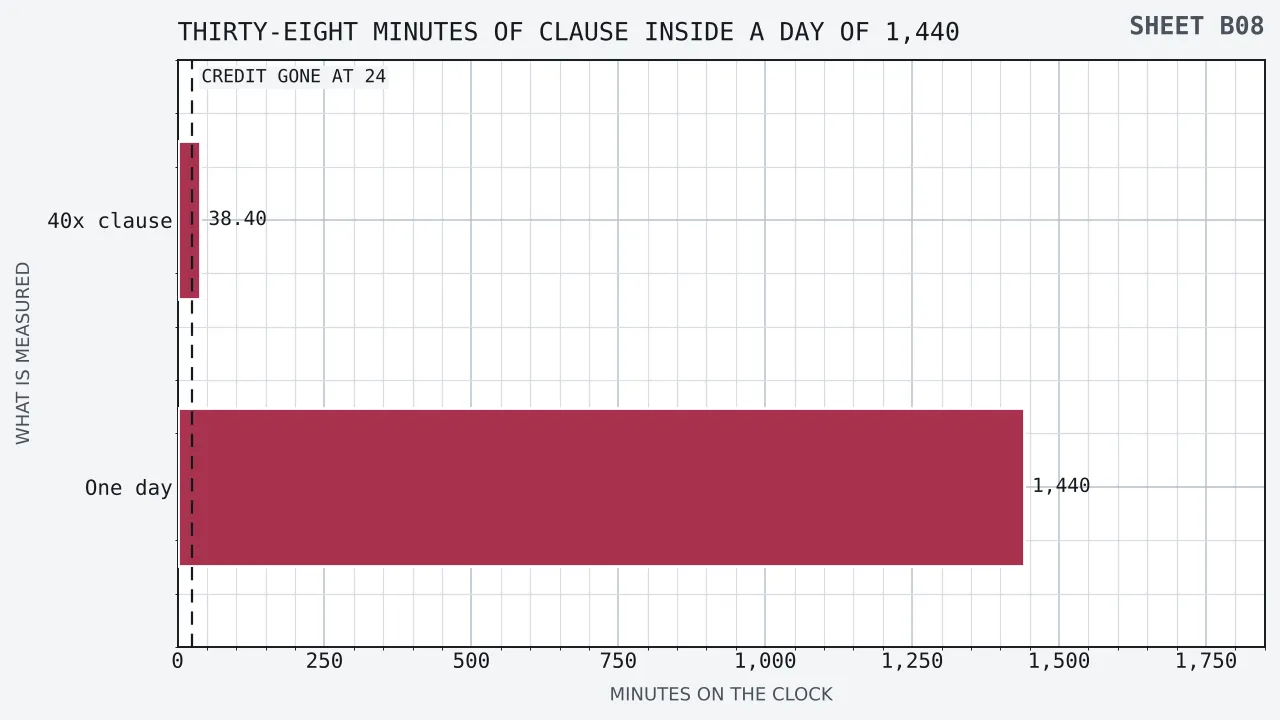
| How long the credit lives | Pressing wanted each day | Share of a day | How that reads in practice |
|---|---|---|---|
| One day | 38.4 min | 2.7% | Done inside one evening, with hours over |
| Three days | 12.8 min | 0.9% | Half an occasion with the phone each day |
| Seven days | 5.5 min | 0.4% | Beneath what a handset absorbs unnoticed |
| Thirty days | 1.3 min | 0.1% | No constraint on anything whatever |
Twenty-three hours and twenty-two minutes of slack wants stating plainly before the qualification arrives, because it is the one line on which a five-spin arrangement beats every larger one. Higher up this market an expiry is the clause that settles outcomes, and a count ten or twenty times this one puts a run outside any window it is likely to be granted. Down at five spins the clock settles nothing, and nobody has ever lost a five-spin pile to a deadline they could not beat.
Forty-eight pence is also the entire sum an expiry is capable of taking, which is the second half of why the clock is harmless. A deadline that removes 48p is a deadline nobody has to write down. Harmlessness of that shape is not a feature of the arrangement and should not be read as one: the window has no teeth because the prize is too small for its own penalties to be worth enforcing, which is a remark about the prize and not about the terms.
One day is the life commonly given to the credited spins themselves, counting separately from whatever runs against the wallet. Five presses occupy a minute, so that clock is met without any attention being paid to it. Keep the pair apart when reading a sheet. The first dates the use of the five spins and the second dates the clearing of the 48p, and 192 presses hang off the second alone.
Nought pence is what a part-finished clause pays, a rule that strands real money further up this market and is close to decorative at five spins. In expectation the credit has gone by press 120 anyway, so an expiry landing at press 150 confiscates a figure the margin had already taken. What such an expiry genuinely removes is the thirty-eight minutes, and those were unrecoverable from the outset: 48p was as far beyond requesting on day one as on the day the clock stopped.
7
Floors and ceilings drafted for sums a hundred times larger
Five pounds is the ceiling on a single online slots cycle under a British licence for anybody of twenty-five and upwards, with £2 applying below that age, and the Commission’s guidance puts 21 May 2025 against the £2 figure and 9 April 2025 against the £5 one. Slots is as far as either reaches, roulette and the rest of a casino lobby falling outside them. Forty-eight pence amounts to 9.6 per cent of the larger ceiling, so the entire credit this page prices would not fund one permitted press at the limit, and a term sheet away from the register tends to put its own maximum stake at a comparable figure.
Four point eight presses is what the credit is worth measured in its own denomination, 48p over a 10p stake, and that comparison shows how far under every published limit the arrangement sits. Ceilings exist to stop somebody discharging a clause in a handful of enormous presses. Where a whole prize is worth under five presses there is nothing for a ceiling to bite on, and the stake rules shaping every other page on this site govern precisely nothing here.
Twenty point eight times its own size is what 48p must reach to clear a £10 smallest permitted withdrawal, with 41.7 times for a £20 one. Neither distance is a wagering condition and neither closes through pressing, since turnover accrues to a requirement and never to a balance. What is worth saying at this count is narrower than the figures suggest: the distance is so great that a payout floor stops being a condition anybody plans around and becomes simply the reason the arrangement has no exit.
Two hundred and eight times the credit is where a £100 cap on what a bonus may win would sit, where a sheet carries one at all, that being the ceiling at the opposite end of the same page of terms. At five spins it governs nothing either. A reader can hold the published maximum and the published minimum up together and find the whole arrangement lying under the lower of them and nowhere near the upper, which is a strange position for an offer to occupy and a routine one for this offer.
Nought is the number of figures in the three paragraphs above drafted with 48p in mind. A payout floor, a stake ceiling and a win cap are each written once and then applied across every size a business issues, so the smallest arrangement on a sheet inherits conditions designed for the largest, and reads as a miniature of a bigger offer while behaving as something else.
8
Proportion, and the rule that does the tying
Five spins is an offer run where no Great Britain licence applies, which places it offshore, and on a page about the ratio between a gift and its condition the duty worth missing is the one that ties those two together. Other losses are real and are set out across this site. What belongs in this part is the single rule that would have kept 192 presses tethered to a prize of 48p, and the consequence of its absence, which is that the bargain at the bottom of the market is word for word the bargain at the top.
Ten is written as a multiple rather than in pounds, and the whole force of the British ceiling lies in that choice. Code 5.1.1 among the social responsibility provisions forbids four things, the third of them stopping a wagering requirement from going past ten times bonus funds. That limb has bound licensees since 19 January 2026, and it spares the technical and the software licences and nothing else. A ceiling written as a multiple shrinks when the gift shrinks, by itself, with nobody obliged to notice that the gift has shrunk. Nothing performs that tying away from the register, and the damage falls hardest at the small end, because 192 presses sounds like a trifle while 38.4 to one is the identical arrangement a four-figure package runs on.
Proportion happens to be the advertising regulator’s own test as well, and its wording reaches time as much as money: a reward is expected to stand in some proportion to what a player lays out in both. Minutes are where the test has nothing to measure against, no rule fixing what proportion means once it is counted in them, so the two quantities can only be set down side by side. One minute goes out. Thirty-eight minutes and twenty-four seconds come back as obligation. Advice from the same regulator on these promotions warns separately against pitching one so that it invites repeated or frequent play, which is the behaviour a prize this small produces almost by design, nobody having yet collected one five-spin pile and considered the matter closed.
One hundred and seventy thousand pounds is the only sum any regulator has published against the terms attached to a no-deposit offer. It landed on 3 July 2025, and what drew it was one line inside a licensee’s bonus rules covering new casino promotions, a line that kept to the business a power it could use as it chose, to close an account down or hold on to what had been won. Fairness and openness in licensing was the condition found breached, and the Commission’s published view of terms built that way is that transparency is what they lack and unfairness is what they can produce. A penalty of that kind is British and the condition behind it is British, and neither crosses the water. Against 48p a discretionary forfeiture costs an offshore business nothing at all to exercise, and the arithmetic of who would bother contesting one is as plain to the business as to the reader.
Two things the regulator tells a player to compare are the activities and the domain names a site shows against what the register records for that licensee, with a click through to the entry in order to do it. Run that comparison on an arrangement issued at five spins and the click lands nowhere, there being no entry. The multiple, the expiry, the payout floor and the forfeiture clause are then knowable only from the page that prints them, and the party printing them is the party they shelter.
Six months is the shortest registration Gamstop Online will take, where a Curaçao licensee has to make one year its briefest long-term exclusion, and the sharper divergence is in reach rather than in length. A Curaçao duty reaches the one operator owing it, over whatever domains that operator runs, and for everywhere else the policy’s remedy is encouragement: the player is to be urged to go through the same procedure again at each of them. No register joins any of it up. British licensees have belonged to the national scheme since March 2020, running their whole customer list past it daily or oftener from the April following. The scheme is candid about where it stops: a registration reaches nobody outside it. Read that as the edge of a protection, and note that no route around it is offered on this page, nor around a gambling bar put up by a bank or at network level.
9
Who a minute suits, and who is paying for it
One minute of pressing given away is plainly a good thing to be handed, and no part of this note has argued against it. The minute costs nothing as it happens, it is over inside a twentieth of a sitting, and whatever it raises is genuine until a clause is laid on top. Somebody already holding an account, handed five spins as a courtesy, has been given something for nothing and ought to press the five times.
Thirty-eight minutes is the price of turning that minute into money, and the honest reading of the price is not that it is long. It is thirty-eight times the gift and 1.6 times the gift’s whole value in expected cost: the worst rate of exchange on this site measured against what is bought, and the mildest measured against a clock.
Forty-eight pence settles the question by being smaller than every threshold it encounters. Smaller than a payout floor by a factor of twenty. Smaller than one permitted press by a factor of ten. Smaller than a win cap by a factor of two hundred. A sum lying beneath every boundary in the terms cannot arrive at any outcome those boundaries describe, and no amount of pressing lifts a sum, because pressing discharges a requirement rather than filling a wallet.
Two courses follow once that is understood, and they are not the two a banner implies. The first is to take the minute and stop there: five presses, no attempt at the clause, an expected 48p surrendered that was never requestable. The second is to spend two occasions with a phone arriving at an expected minus £0.29 and a wallet the margin emptied at minute twenty-four. Arithmetic supports the first course, and the first course is the one nobody is sold.
Thirty-eight point four to one is the ratio to carry away, and the context to carry with it is that the ratio holds whatever the count. A pile ten times this size asks ten times as long for ten times as much on identical terms, so the question actually being answered is never about five spins. It is whether 38.4 presses of obligation is a fair price for one press of entertainment, and the answer does not shift when the banner does.
Questions
- How many minutes does a 5 free spins no deposit offer ask for?
- Thirty-eight point four of them at the reels, with one more for the five credited presses. Forty times a credit of 48p puts £19.20 over the reels, which is 192 presses of 10p, and twelve seconds apiece fills 2,304 seconds. Measured against a sitting of twenty-two minutes and rounded upward, the clause comes to two occasions with a handset. Both the rate of play and the length of a sitting are declared assumptions, and neither was timed.
- What is a five-spin pile worth before the clause touches it?
- Fifty pence of staking, five presses at 10p. Two pence is the margin where ninety-six come back in each hundred, so 48p is the credit those presses are expected to raise. It arrives as bonus funds rather than money, and the clause measures itself against the 48p while the fifty pence of staking underneath plays no part in the reckoning.
- Why is the condition called longer than the prize is worth?
- Because it outlasts the prize in four separate units. The clause asks 192 presses against five given away, 38.4 minutes against one minute, and £19.20 of staking against fifty pence. In money the gap is sharper still: four pence out of each pound of £19.20 makes the expected cost of satisfying the condition 76.8p, which is 1.6 times everything a 48p credit contains, and the 28.8 pence of overshoot is the expected position at the foot of the run.
- Does a short expiry strand a five-spin offer?
- Hardly ever, and this is the one line where the smallest pile beats every larger one. At 38.4 minutes the clause takes 2.7 per cent of a twenty-four hour window and leaves 23 hours 22 minutes unspent, so even the tightest clock in common use is comfortable. The window has no teeth because the prize is too small for its own penalties to be worth enforcing, which is a remark about the prize and not about the terms.
- Where does a forty times clause leave 48p in expectation?
- At minus 29 pence, and the route there is short. Where ninety-six come back in each hundred the margin stands at four pence in the pound, forty applied to the credit sends £19.20 over the reels, and 160 per cent of a credit departs with the house across that distance. Expect the run to stop before the clause does: 0.4p leaves the credit on each press, so 120 presses and twenty-four minutes empty it, while the clause wants 192 presses and 38.4 minutes.
- Can pressing faster make the thirty-eight minutes worth spending?
- It shortens the clock and alters nothing else. Six seconds a press brings the 192 presses in at 19.2 minutes, nine seconds at 28.8 minutes and twenty seconds at one hour four, while the count itself stays where the multiple and the 10p denomination fixed it. Minus 29 pence holds across every rate, no term for speed appearing anywhere in the arithmetic behind it.
- What does the missing British licence cost at this size?
- Proportion, which is the loss that bites on the smallest arrangement in the market. Five spins is an offer run where no Great Britain licence applies, so the ten times ceiling in social responsibility code 5.1.1, binding since 19 January 2026, does not reach it. That ceiling is a multiple rather than a sum, so under a licence a smaller gift carries a smaller obligation automatically. Nothing performs that tying offshore, which is why 192 presses are wanted for a prize of 48p on the same bargain a four-figure package runs on.
- Is it worth taking five free spins at all?
- The minute is worth taking where an account already exists, since five presses cost nothing and are done inside a twentieth of a sitting. Attempting the clause is not worth it: two occasions with a phone for an expected minus 29 pence, a credit the margin empties at minute twenty-four, and a sum that would have to grow 20.8 times over to clear a £10 payout floor. Taking the spins and leaving the condition alone costs exactly one minute.