Note D10 Revision 1 Terms read 17 October 2026
30 free spins, no deposit required, keep what you win: the clause it lifts and the floor it leaves behind
Thirty presses at 10p lay out £3.00 and are expected to leave £2.88 standing after six minutes. The promise in the headline removes a staking clause worth 3 h 50 min 24 s of pressing. It removes none of the other clocks, and against an exit floor of £10.00 the £2.88 is kept in the sense that it stays where it is.
What is kept £2.88 What it has to reach £10.00 Clause lifted 3 h 50 min
What a no wagering promise leaves standing
Advertising has been bought for every destination below. A fee reaches this site when a reader goes on to register, and no figure on this page moves one way or the other because of it.
-
01Mobile Free Spins
Betportal
Ceiling as a multiple
What lands€15.00150 spins at 10c, which is this site's figure and not the operator'sThe run17 h 30 minTurning over 525.00 at 10p means 5,250 presses, or about 48 phone sittings of 22 minutes. Timed at 10p a press and 12 seconds between presses, both of which this site assumes rather than measures.The wait to be paidNOT PUBLISHEDThis operator puts no withdrawal band in its own terms, so there is nothing honest to print here.Spins valued at this site's own 10p a spin
What lands
Spins, at a price15.00150 of them at 10c apiece, a figure belonging to this site rather than to the operatorMatch, and other creditno figure300% of three deposits, to a ceiling of €1,000. Not a sum until money of yours makes it one, so this row totals nothing and carries nothing downwardsThe run
Handed back on the spins(0.60)Each press stakes its own value and returns 96 per cent, which leaves this much with the house from the opening pressPlay-through 35x on the bonus(20.16)Taking 14.40 round 35 times over means 504.00 through the machines, of which 20.16 is the expected cost, and 17 h 30 min of pressing at the pace aboveWhat counts towards it100%Slots only, with no percentage published anywhere, so the row above assumes the whole of each stake countsWhat never clears
Limit on the winningsstated5x the bonusDeducted on the way outno figureNothing is published as a figure here, so this row removes nothingLeast that can leaveno figureNo figure is published, so nothing on this timer is pinned down by oneLeast deposit, and the rung over ityour own€20 a stage. Published in euros, so no rung is named at all: this site's ladder is a sterling oneThe window on the creditstated14 daysBiggest stake while it runsstated€5Removed outright by rulestatedNot publishedVerified before a payoutstatedDocuments before the first withdrawalNever clears€15.00Not a penny of it gets out, so the whole of what landed stands on this rowNo Great Britain licence
Licence held in Anjouan, Comoros, the company named is BetPortal Gaming Ltd, with Excite Ultra Media Ltd, quoted under ALSI-202601040-FI2.
Terms read 17 October 2026
Open the offer at Betportal, opens in a new window -
02Mobile Free Spins
WinBeast
Ceiling as a sum
What lands€50.00500 spins at 10c, which is this site's figure and not the operator'sThe run2 d 18 hTurning over 2,000.00 at 10p means 20,000 presses, or about 182 phone sittings of 22 minutes. Timed at 10p a press and 12 seconds between presses, both of which this site assumes rather than measures.The wait to be paidNOT PUBLISHEDThis operator puts no withdrawal band in its own terms, so there is nothing honest to print here.Spins valued at this site's own 10p a spin
What lands
Spins, at a price50.00500 of them at 10c apiece, a figure belonging to this site rather than to the operatorMatch, and other creditno figure50% to 100% of five deposits, each to a ceiling of €1,000, and a €650 free bet. Not a sum until money of yours makes it one, so this row totals nothing and carries nothing downwardsThe run
Handed back on the spins(2.00)Each press stakes its own value and returns 96 per cent, which leaves this much with the house from the opening pressPlay-through 40x on the bonus and the winnings from the spins(76.80)Taking 48.00 round 40 times over means 1,920.00 through the machines, of which 76.80 is the expected cost, and 2 d 18 h of pressing at the pace aboveWhat counts towards it100%Slots, titles vary by country, with no percentage published anywhere, so the row above assumes the whole of each stake countsWhat never clears
Limit on the winningsstated€100 a batch of spinsDeducted on the way outno figureNothing is published as a figure here, so this row removes nothingLeast that can leaveno figureNo figure is published, so nothing on this timer is pinned down by oneLeast deposit, and the rung over ityour own€20 a stage. Published in euros, so no rung is named at all: this site's ladder is a sterling oneThe window on the creditstated7 days, spins 1 dayBiggest stake while it runsstatedNot publishedRemoved outright by rulestatedNot publishedVerified before a payoutstatedDocuments before the first withdrawalNever clears€50.00Not a penny of it gets out, so the whole of what landed stands on this rowNo Great Britain licence
Licence held in Curaçao, no company named anywhere on the site.
Terms read 17 October 2026
Open the offer at WinBeast, opens in a new window -
03Mobile Free Spins
EliteSpin
Longest spin window
What lands£50.00500 spins at 10p, which is this site's figure and not the operator'sThe run2 d 18 hTurning over 2,000.00 at 10p means 20,000 presses, or about 182 phone sittings of 22 minutes. Timed at 10p a press and 12 seconds between presses, both of which this site assumes rather than measures.The wait to be paidNOT PUBLISHEDThis operator puts no withdrawal band in its own terms, so there is nothing honest to print here.Spins valued at this site's own 10p a spin
What lands
Spins, at a price50.00500 of them at 10p apiece, a figure belonging to this site rather than to the operatorMatch, and other creditno figure50% to 100% of five deposits, each to a ceiling of £1,000. Not a sum until money of yours makes it one, so this row totals nothing and carries nothing downwardsThe run
Handed back on the spins(2.00)Each press stakes its own value and returns 96 per cent, which leaves this much with the house from the opening pressPlay-through 40x on the bonus and the winnings from the spins(76.80)Taking 48.00 round 40 times over means 1,920.00 through the machines, of which 76.80 is the expected cost, and 2 d 18 h of pressing at the pace aboveWhat counts towards it100%Slots, with no percentage published anywhere, so the row above assumes the whole of each stake countsWhat never clears
Limit on the winningsstated5x the bonusDeducted on the way outno figureNothing is published as a figure here, so this row removes nothingLeast that can leaveno figureNo figure is published, so nothing on this timer is pinned down by oneLeast deposit, and the rung over ityour own£20 a stage. It lands square on the £20.00 rung, so none of yours is left perched on topThe window on the creditstated7 days, spins 3 daysBiggest stake while it runsstatedNot publishedRemoved outright by rulestatedNot publishedVerified before a payoutstatedDocuments before the first withdrawalNever clears£50.00Not a penny of it gets out, so the whole of what landed stands on this rowNo Great Britain licence
Licence held in Costa Rica, the company named is PrimeTier Limited.
Terms read 17 October 2026
Open the offer at EliteSpin, opens in a new window -
04Mobile Free Spins
Crown Jewelz
Multiple unpublished
What lands£15.00150 spins at 10p, which is this site's figure and not the operator'sThe runNOT TIMEDThis operator does not publish the play-through multiple in its own terms. The multiple is the one figure the clock cannot work around, so the run is left untimed.The wait to be paidNOT PUBLISHEDThis operator puts no withdrawal band in its own terms, so there is nothing honest to print here.Nothing reckoned
What lands
Spins, at a price15.00150 of them at 10p apiece, a figure belonging to this site rather than to the operatorMatch, and other creditno figure200% of the first deposit, then 150% twice, each to a ceiling of £1,000. Not a sum until money of yours makes it one, so this row totals nothing and carries nothing downwardsThe run
Play-throughno figure40x the bonus, reported rather than published by the operatorWhat counts towards itno figureSlots, with no percentage published anywhere, so the row above assumes the whole of each stake countsWhat never clears
Limit on the winningsstatedNot publishedDeducted on the way outno figureNothing is published as a figure here, so this row removes nothingLeast that can leaveno figureNo figure is published, so nothing on this timer is pinned down by oneLeast deposit, and the rung over ityour own£20. It lands square on the £20.00 rung, so none of yours is left perched on topThe window on the creditstatedNot publishedBiggest stake while it runsstatedNot publishedRemoved outright by rulestatedNot publishedVerified before a payoutstatedDocuments before the first withdrawalNever clearsNOT RECKONEDThis operator leaves the play-through multiple out of its own terms, so nothing below the fourth step can be worked out.No Great Britain licence
Licence held in Curaçao, number not verified, no company named anywhere on the site.
Terms read 17 October 2026
Open the offer at Crown Jewelz, opens in a new window
Only the middle reading comes out of arithmetic belonging to this site. The multiple laid against what lands gives the turnover asked for; dividing that by 10p a spin gives the presses; dividing those by 300 an hour gives the hours, a press on a handset being taken here at 12 seconds from the one before. Both figures are assumptions rather than measurements of anybody: nothing was played and nothing was held a stopwatch to. Anybody quicker should divide the press count by a rate of their own, which is why the presses are printed alongside the hours instead of being summarised away.
The first reading is what arrives before any condition is laid against it. Spins carry no unit of their own so one gets supplied: where an operator values its own spin that figure is used and attributed, and where it does not, this site's 10p a spin stands in and everything below moves with it. The third reading belongs to the operator entirely. It is a withdrawal band quoted from published terms, and a blank there means none was published rather than that nobody looked.
The total along the foot answers what the hours leave open, which is whether any of the running ends anywhere. It is what arrived, less whatever is still standing once the play-through has been paid for at 96 per cent return to player and once a published limit, a published deduction and a published floor beneath the least that can leave have each had a turn. It appears again in pence in the pound, the only fair way of holding a small offer up against a large one. It describes an offer rather than an evening, and where the conditions price out what arrived, a timer prints nothing getting out instead of a negative sum.
Cashiers on a handset take deposits off a row of preset buttons, so a least deposit given in pounds is raised to the next rung of the ladder used here, £10, £20, £25, £50, £75 and £100, and the timer shows what is left perched on it. That money is the reader's own and enters no sum at all. Given in euros it prints untouched, the ladder being sterling. Three words may occupy the figure column where no figure belongs. Stated is a published term that costs something while leaving no number to subtract. No figure is a term nobody has quantified, or a credit that is not a sum until money of yours makes it one. Your own is money of yours, which belongs in none of this.
None of the operators above is licensed in Great Britain, so not one duty that licence carries reaches any of them. Membership of Gamstop Online is compulsory for every online gambling company licensed in Great Britain, which means that shutting yourself out through the scheme shuts you out of none of these. The limit of ten times the bonus funds on a wagering requirement, running since 19 January 2026 under Social Responsibility Code 5.1.1, is a condition of the same licence and binds only whoever holds one. Off that licence, the Gambling Commission writes of consumers meeting unfair gaming practices, financial loss and no recourse when matters go wrong, and lists blocked payouts and withdrawal limits pitched too high to reach among the things it has seen. No account at any of them may be held by anybody under 18.
Every term on a timer is its operator's own and every timer carries the day somebody read it. The oldest of those readings is 17 October 2026. What binds a reader is an operator's full terms and never a line printed here.
1
Six minutes of pressing, and the £2.88 behind them
Three pounds is what thirty presses at 10p commit, and that sum is the only concrete quantity in the headline. Two further inputs are needed before the count means anything to anybody. One is the denomination, 10p here, which is what offers of this size are issued at. The other is the interval, twelve seconds on a handset, adopted as an assumption of this site and held against no watch at all.
Twelve pence of the £3.00 is the house’s share, since ninety-six pence comes back on each staked pound at the rate applied across this site, leaving £2.88 as the sum expected to be standing once the thirtieth press settles. That residue is the object the whole page is about. Everything the headline promises, everything the terms qualify and every deadline in the sheet attaches to £2.88 and not to the £3.00 that produced it.
Three hundred and sixty seconds is the whole handout at the assumed interval, which is six minutes. A sitting on this site is taken to run twenty-two minutes, an assumption like the others, so the entire advertised experience occupies rather more than a quarter of one sitting and rather less than a third. A reader could collect the lot on a bus and still be looking out of the window before the stop.
| Quantity | Reading |
|---|---|
| Presses promised | 30 |
| Committed at 10p each | £3.00 |
| House share at 96 pence back | £0.12 |
| Residue expected | £2.88 |
| Seconds at the assumed interval | 360 |
| Share of one assumed sitting | 0.27 |
Twenty-eight pounds eighty an hour is the rate at which value arrives during those six minutes, £2.88 over a tenth of an hour, and it is the single most flattering figure on this page. It holds for exactly 360 seconds. What happens either side of those six minutes is the business of parts three to eight, and the rate there is a good deal less generous.
Offers worded this way are run from outside the British register and hold no Great Britain licence. Where the subject is a promise, what bites hardest is the body of rules deciding what a promise may be made to carry. Part nine sets four of them out with the figures from this page attached. None of them touches the £2.88. All of them touch the sentence that advertised it.
2
Three hours fifty is the weight the phrase takes off
One hundred and fifteen pounds twenty is what a forty times clause would demand of £2.88, and the phrase in the headline is a promise not to demand it. That is a real thing to be given, and it deserves pricing properly before this page starts dismantling it.
One thousand one hundred and fifty-two presses is £115.20 cut into pieces of 10p. Thirteen thousand eight hundred and twenty-four seconds is what those presses consume at the assumed twelve, which is 3 h 50 min 24 s, and eleven sittings once 10.47 is carried up. Set that beside the six minutes of handout and the ratio is 38.4 to one, which is the figure every page in this section keeps arriving at wherever forty times is written over a residue.
Four pounds sixty-one is what the promise is worth in money, and the sum comes from two subtractions rather than one. A clause of forty times would be expected to close at minus £1.73, four pence of every pound disappearing forty times over against a residue that only holds sixty pence of slack per pound. Without the clause the expectation stays at £2.88. The distance between those two outcomes is £4.61.
| Reading | Staking demanded | Presses | Time at the assumed pace | Sittings | Expected close |
|---|---|---|---|---|---|
| Forty times over the residue | £115.20 | 1,152 of them | 3 h 50 min 24 s | 11 | minus £1.73 |
| Ten times, the licensed limit | £28.80 | 288 | 57 min 36 s | 3 | plus £1.73 |
| Nothing at all, as promised | £0.00 | 0 | 0 min | 0 | plus £2.88 |
Row three is the row the headline sells, and on its own terms the headline is telling the truth. Nought presses are owed. Nought hours are owed. The £2.88 does not have to be put back over the reels to become the reader’s, and that single difference is worth eleven sittings of a stranger’s evening.
11 sittings lifted off one residue of £2.88
Nothing in that table is a claim about what any given sheet asks. Forty times is the multiple this site costs a play-through at throughout, and ten times is as far as such a requirement may be taken over bonus money by the holder of a Great Britain licence, a limit biting from 19 January 2026 onwards. The third row exists because a promise to charge nothing is precisely what the key phrase on this page asserts.
3
Four clocks the promise says nothing about
Removing a staking clause removes one condition out of several, and the other four survive it untouched. Two of them are deadlines proper and two are thresholds, and each is capable of doing to £2.88 exactly what a play-through would have done, which is to keep it out of a bank account.
First is a window on the spins. The presses have to happen inside a stated period from the moment they land, and at six minutes of work this is the one condition on the page that nobody fails. A window of twenty-four hours is 240 times the length of the task. A window of seven days is 1,680 times it.
Second is a window on the residue. Where one exists it runs from the moment the thirty presses finish, governs how long the £2.88 may sit before it has to be withdrawn or used, and is the deadline that actually decides the outcome. Part eight prices what its expiry takes.
Third is a floor under any withdrawal, which is a threshold rather than a clock but works on the money in the same way. Fourth is a ceiling over what may be taken from the offer at all. Neither is removed by a sentence about wagering, because neither is a wagering requirement.
| Condition | Removed by the phrase | What it costs here |
|---|---|---|
| Staking clause at forty times | Yes | 3 h 50 min 24 s |
| Window on the thirty presses | No | 6 min of work |
| Window on the residue | No | The whole £2.88 |
| Floor under a withdrawal | No | £7.12 short |
| Ceiling over the winnings | No | Bites above £50.00 |
Row one is the only yes in the column and it is doing an enormous amount of advertising work. A reader scanning the headline takes it as an assurance about getting paid. What it actually assures is the absence of one named obstacle, and the obstacle it names is the only one of the five that six minutes of free pressing was never going to produce in a form worth arguing about.
Two pounds eighty-eight is small enough that the threshold rows matter more than the clock rows, which inverts the usual ordering on this site. On a credit of £50.00 a withdrawal floor is a formality and a staking clause is the whole problem. On a residue of £2.88 the staking clause has been waived and the floor is the whole problem. Size decides which condition is the live one.
4
Kept, and £7.12 short of the door
Ten pounds is the figure this page sets as the smallest sum a cashier will send, and it is an assumption adopted so the arithmetic can be written down rather than a reading of any sheet. Against it, a residue of £2.88 is 28.8 per cent of the way to being movable. The shortfall is £7.12, which is 2.47 times the residue itself.
Kept is therefore the precise word and it has been chosen carefully by somebody. The money is credited, it belongs to the account, no clause requires it to be staked, and it cannot be taken out. Each of those statements is true at the same moment, and only the first three appear in the advertisement.
Two figures on this page are adopted rather than found. The smallest payment a cashier will send is taken at £10.00 and the ceiling over the winnings at £50.00, and no published rule sets either. A reader whose sheet says £5.00 or £20.00 substitutes the figure and runs the same divisions, and the shape of the answer holds: a residue of £2.88 is priced by how many multiples of itself the exit stands at.
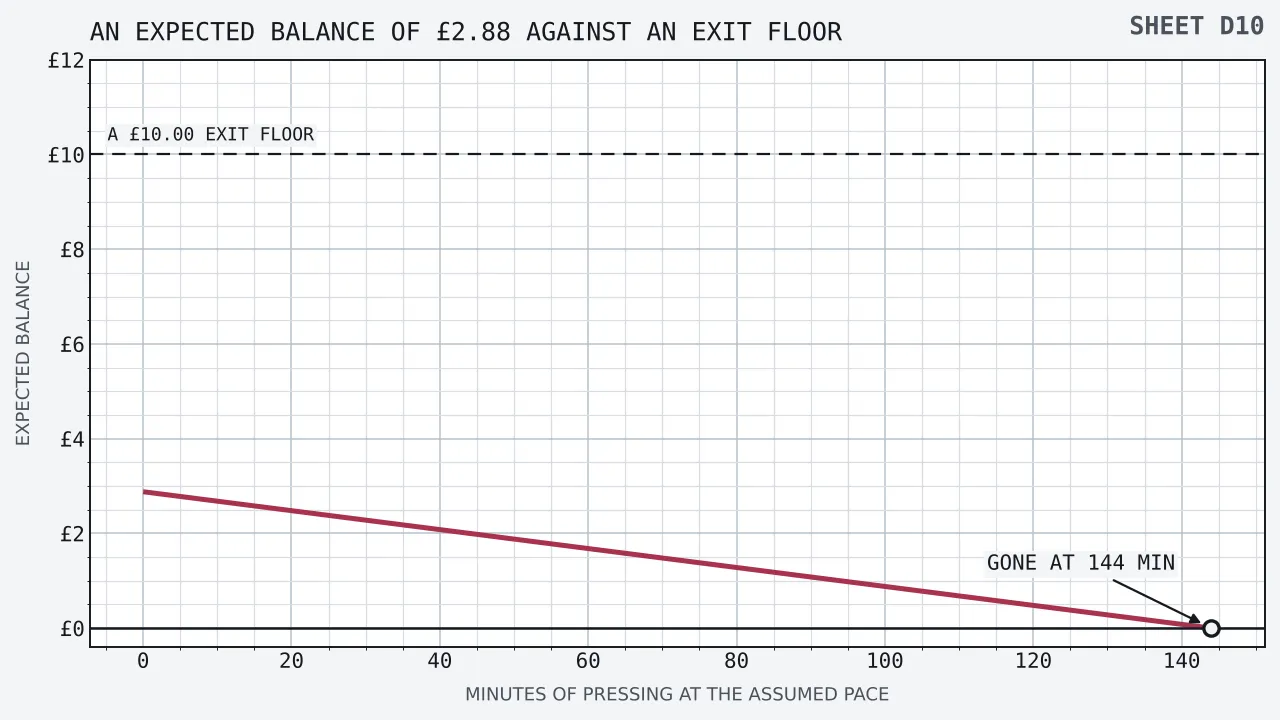
Nothing on that plate rises, and the flatness of the statement is the point. In expectation each 10p press returns 9.6p, so the balance drops 0.4p at a time and a line drawn through the expectation only ever has one direction. The exit floor is not approached slowly. It is not approached at all.
Luck is what the plate leaves out, and leaving it out is honest rather than evasive. A real sequence of presses scatters around that line and some readers will land above £10.00. Part five puts a bound on how many. The expectation is drawn here because there is nothing else to weigh an arrangement on before anybody has entered it.
Twenty pounds as a floor doubles the problem without changing its shape, leaving £2.88 at 14.4 per cent of the exit and £17.12 short. Five pounds as a floor would leave the residue 57.6 per cent of the way there and £2.12 short. In none of the three cases does a promise about wagering help, because in none of the three cases is wagering what is standing in the way.
5
What it costs to press towards the exit
Seventy-two pounds of staking is what the residue buys before expectation runs it down to nothing, £2.88 divided by the four pence each staked pound surrenders. At 10p a press that is 720 presses, 8,640 seconds at the assumed interval, 2 h 24 min, and seven sittings once 6.55 is carried up.
Two hours and twenty-four minutes is therefore the expected life of the kept money if the reader tries to turn it into withdrawable money by playing. Nobody has to press at all, which is the whole novelty of the offer, and the floor is what makes pressing the only route that does not involve a payment. So the promise removes an obligation to press and the floor reinstates an incentive to press, which is a neat piece of drafting from one side of the table.
Twenty-eight point eight per cent is the most generous bound available on reaching £10.00 before the balance is gone, and the arithmetic behind it is short. Were the game to carry no house margin at all, the chance of a balance climbing from £2.88 to £10.00 before touching nothing would be 2.88 divided by 10, which is 0.288. A margin of four pence on each staked pound drags the true figure under it. The bound is this site’s own working and assumes nothing about any particular reel.
| Floor the cashier sets | Multiple of the residue | Bound on reaching it | Value of the attempt at best |
|---|---|---|---|
| £5.00 | 1.74 | 57.6 per cent | £2.88 |
| £10.00, used here | 3.47 | 28.8 per cent | £2.88 |
| £20.00 | 6.94 | 14.4 per cent | £2.88 |
Column four is identical down the table and that is not a mistake. Multiply the bound by the floor in any row and the answer is £2.88 every time, because a bound computed on a margin of nothing cannot create value out of nothing. Raising the floor lowers the chance in exact proportion to the prize, and the real figure in every row sits under the one printed, by however much four pence in the pound is worth across the presses it takes to get there.
Seven sittings is what the attempt costs in attention whichever row applies, since the £2.88 funds the same 720 presses regardless of what the reader is aiming at. Six minutes of advertised play has turned into 2 h 24 min of unadvertised play, and the only thing that changed was the discovery of a floor.
6
The other route out, priced in the reader’s own money
Seven pounds twelve is the second way over the floor and it is the one the structure is pointing at. Paying that in lifts the balance to exactly £10.00, at which point a withdrawal becomes possible, and the account then holds 71.2 per cent the reader’s own money against 28.8 per cent handed over for nothing.
Nought is the amount of the £7.12 that the offer contributes. A no-deposit headline whose residue sits under the withdrawal floor is, in that specific sense, a deposit offer with the deposit deferred to the end rather than demanded at the start. The order of events differs from an ordinary sign-up and the sums do not.
Two further things usually attach to that payment and both are worth naming. A sum paid in is generally not withdrawable the instant it arrives, and a cashier commonly wants to see it staked at least once first. And a payment is the event that triggers the identity work, so a reader who has pressed thirty times without showing anybody a document meets that queue on the way to recovering £2.88.
| Route to the floor | Reader’s money | Given money |
|---|---|---|
| Pay in the shortfall | £7.12 | £2.88 |
| Press for it and succeed | £0.00 | £10.00 |
| Press for it and fail | £0.00 | £0.00 |
Row one is certain, row two carries a bound of 28.8 per cent and row three carries the remainder. A reader choosing between them is choosing between spending £7.12 of their own and spending 2 h 24 min of their evening on a bet they are more likely to lose than win. Those are the two prices of a kept £2.88, and the headline mentions neither.
One pound twenty an hour is what the pressing route pays if it is read as work, £2.88 of possible gain spread across the 2 h 24 min the money is expected to last. The paying route has no hourly rate because it takes about a minute. It is simply £7.12.
7
A ceiling seventeen times above the money
Fifty pounds is taken here as a ceiling over what the offer can ultimately yield, another figure adopted so that the division can be shown and not a reading of any particular sheet. Against the £2.88 expected from thirty presses it stands at 17.36 times the residue, which puts it a very long way out of the ordinary path.
Nought is the effect a ceiling at that height has on the typical reader, and that is exactly why a ceiling is cheap for the party writing it. A term that bites on one reader in twenty costs almost nothing to grant and reads, in a list of conditions, as generous. A bound on reaching £50.00 from £2.88 before the balance is gone sits at 5.76 per cent even with no margin working against it.
Two conditions are therefore operating in opposite directions on the same residue and both are invisible in the headline. The floor at £10.00 cuts off the bottom of the distribution, where almost everybody is. The ceiling at £50.00 cuts off the top, where almost nobody is. What survives between them is a band from £10.00 to £50.00, which a reader reaches less than three times in ten at the most generous reckoning.
£2.88 sits between a floor 3.47 times above it and a ceiling 17.36 times above it
Three hundred and forty-seven per cent and 1,736 per cent are those two multiples written as percentages of the residue, and writing them that way is the clearest test of whether a condition is doing any work. A condition pitched at three and a half times the money is a condition almost everybody meets. One pitched at seventeen times is a condition almost nobody meets. Both appear as single lines in the same list.
Nothing here says a ceiling is improper. It says that a ceiling and a floor are priced by where they sit against the sum they are written over, and that on a residue of £2.88 they sit in utterly different places. The useful question when reading a list of conditions is not whether a figure is large but how many multiples of the actual money it stands at.
8
What the end of the window actually removes
Seven days is the window this page models over the residue, declared as an assumption and not read off anything. At its close the £2.88 is swept and the account returns to nought. The interesting question is what that sweep actually costs, and on the figures above the answer is strange enough to be worth four paragraphs.
Nought pounds is what it costs a reader who never reached the floor. The £2.88 was credited, it was theirs in every sense a term sheet uses, and it could not be moved to a bank. An expiry removes a holding rather than money. Where the floor stands above the balance, the deadline that looks most alarming in the terms is the one condition on the page with no cash consequence whatever.
Seven pounds twelve is what it costs the reader who paid in to cross the floor and then let the clock run out, because that reader put their own money behind the residue and the sweep may take the balance with it. The expiry is cheap for the person who did nothing and expensive for the person who acted on the offer, which is the inversion this part exists to print.
| What the reader did | Balance at the close | Own money in it | Cost of the sweep |
|---|---|---|---|
| Pressed thirty times and stopped | £2.88 | £0.00 | £0.00 |
| Pressed on and ran the residue out | £0.00 | £0.00 | 2 h 24 min |
| Paid in £7.12 and waited | £10.00 | £7.12 | £7.12 |
| Paid in, crossed, withdrew in time | £0.00 | Returned | Nothing |
Row four is the only route on the page that ends with money in a bank account, and it costs £7.12 of the reader’s own funds plus whatever the payout rail takes in days. Row one is the route most people take and it ends exactly where it started, having cost six minutes. Reading the two together is the honest summary of what a no-wagering promise delivers at this size.
Two deadlines are therefore doing quite different jobs. The window on the spins is satisfied by six minutes of work and is close to unmissable. The window on the residue is unmissable for a different reason, which is that for most readers there is nothing behind it worth missing. Only the reader who crossed the floor has a real deadline, and that reader is in a minority the arithmetic above has already bounded.
9
Rules about what a headline is allowed to carry
Offers phrased this way sit outside the Great Britain licence, and where the subject is a sentence the duties worth itemising are the advertising ones. Four are set out below, each tied to a figure already established above, so that what is missing can be measured instead of deplored.
Calling a thing free is governed first. The advertising regulator’s guidance on that word is narrow: it is unavailable where qualifying obliges a customer to put their own money at stake. Part six priced that qualification at £7.12. A promise of something for nothing, fastened to a residue of £2.88 that cannot leave an account without a payment of 2.47 times itself, is the arrangement the guidance was written about.
Prominence is governed second. Promotional material has to set out a significant condition plainly enough to be noticed, in every instance where its absence would mislead. Measured against £2.88, a floor standing at 3.47 times the money and a ceiling standing at 17.36 times it are not small print. They are the two figures deciding whether anything is ever paid out at all.
Which conditions count as significant is the third thing, and it has been written out rather than left to judgement. The published list reaches restrictions on who may take part, requirements to deposit and to wager, and limits of time on claiming or using what is offered. All three stand in part three above, and it is the last of them that somebody drawn in by a promise about keeping winnings is least likely to hunt for.
A published ruling supplies the fourth, and it turns on a deadline rather than on a sum. A ruling dated 17 July 2024 concerned a free bet of ten pounds which turned out to depend on a text being answered by a stated hour. The advertisement had said nothing about that hour, and the regulator treated the silence as an omission both significant and apt to mislead. Six minutes of pressing sitting inside a seven-day window on the residue is the same shape of silence in a different product.
£7.12 is the figure four advertising duties would have had to reach
Thin prominence has a stated consequence as well. The British gambling regulator’s own position is that conditions of that kind, shown without enough emphasis, make the advertisement a misleading one. Where no Great Britain licence is held, none of these duties binds anybody. The thing given up is not money. It is a standard somebody else must satisfy before the sentence goes up at all.
10
Who a promise of this shape genuinely suits
Six minutes against a £10.00 floor is the whole proposition reduced to two figures, and it suits a reader who wants six minutes and expects nothing else. Taken that way the offer is honest and cheap: thirty presses arrive, cost nothing, consume rather more than a quarter of one assumed sitting, and leave a figure on a screen.
Three hours fifty minutes and twenty-four seconds is what the phrase saves anybody who would otherwise have faced forty times over £2.88, and that saving is genuine. It is also a saving against an obligation most readers would have abandoned rather than discharged, since eleven sittings for a residue expected to close at minus £1.73 is not a bargain anybody takes twice.
Two hours and twenty-four minutes is what the offer costs the reader who takes the floor seriously and presses towards it, and the bound on success is 28.8 per cent before the house margin is allowed for. Seven pounds twelve is what it costs the reader who pays over the floor instead. Those are the two real prices and the headline names neither, because the headline is about a condition that has been removed rather than the conditions that remain.
Two pounds eighty-eight is the number to carry away, and the useful thing about it is not its size but its position. It sits at 28.8 per cent of a withdrawal floor and 5.76 per cent of a winnings ceiling, it is expected to fund 720 presses if pressed, and it expires at the end of a window that costs most readers nothing because most readers were never going to move it. Kept is accurate. Paid is a different word.
Questions
- What exactly does the keep what you win phrase remove?
- One condition, which is the requirement to stake the winnings before they can be withdrawn. On thirty presses of 10p the residue expected is £2.88, and forty times over that residue would be £115.20 of staking, 1,152 presses, 3 h 50 min 24 s on the twelve-second interval assumed here, and eleven sittings. Lifting it moves the expected close from minus £1.73 to plus £2.88, a difference of £4.61. Nothing else in the terms is touched by the phrase.
- How much is 30 free spins worth before any condition applies?
- Thirty presses at 10p commit £3.00, and ninety-six pence back on each staked pound leaves an expected £2.88 standing. The pressing takes 360 seconds at the assumed twelve seconds a press, which is six minutes, or rather more than a quarter of the twenty-two minutes this site takes a sitting to be. Both the interval and the sitting length are assumptions of this site and neither was timed.
- Can £2.88 be withdrawn?
- Not where a cashier sets its smallest payment at £10.00, which is the floor this page models as an assumption. The residue reaches 28.8 per cent of that floor and falls £7.12 short, so it is credited, it belongs to the account, no clause requires it to be staked, and it still cannot be moved to a bank. Each of those statements holds at the same moment, and an advertisement generally prints the first three.
- What happens if the residue is played up towards the floor?
- Pressing it towards the floor buys £72.00 of staking, which is the residue over the four pence each staked pound surrenders, and then it is expected to be gone. At 10p a press that is 720 presses, 2 h 24 min at the assumed pace and seven sittings. The most generous bound on climbing from £2.88 to £10.00 before touching nothing is 2.88 over 10, which is 28.8 per cent, and that bound assumes no house margin at all. Four pence on each staked pound drags the true figure under it.
- Is paying in the shortfall the better route?
- It is the certain one rather than the better one. Adding £7.12 lifts the balance to £10.00, at which point 71.2 per cent of the account is the reader’s own money and 28.8 per cent was handed over for nothing. A sum paid in is commonly not withdrawable the moment it arrives, and the payment is usually the event that starts the identity work, so the queue arrives on the way out rather than on the way in.
- What does a ceiling on the winnings do at this size?
- Almost nothing, which is why it is cheap to grant. A ceiling of £50.00 stands at 17.36 times a residue of £2.88, and the most generous bound on reaching it before the balance is gone is 5.76 per cent. The floor cuts off the bottom of the range where nearly everybody is and the ceiling cuts off the top where nearly nobody is, and both appear as single lines in the same list of conditions.
- Does the expiry on the winnings cost anything?
- For most readers it costs nothing at all, which is the oddest finding on this page. Where the withdrawal floor stands above the balance, a sweep at the end of the window removes a holding rather than money, because the holding was never movable. It becomes expensive only for the reader who paid £7.12 of their own money over the floor and then let the clock run out, so the deadline is cheap for whoever did nothing and dear for whoever acted.
- Which conditions must an advertisement spell out?
- Every significant one, set out plainly enough to be noticed, in every instance where its absence would mislead. What counts as significant has been written out: restrictions on who may take part, requirements to deposit and to wager, and limits of time on claiming or using what is offered. A ruling dated 17 July 2024 concerned a free bet of ten pounds depending on a text answered by a stated hour that the advertisement never mentioned, and the silence was treated as an omission both significant and apt to mislead. Conditions shown without enough emphasis make the advertisement a misleading one, on the British gambling regulator’s own position.
- Is the word free available for an offer like this?
- Not where qualifying obliges a customer to put their own money at stake, which is the advertising regulator’s guidance on that word. Here it points straight at the £7.12 paid in to cross the withdrawal floor, a residue of £2.88 being unable to leave an account without a payment of 2.47 times itself. Not one of these advertising duties reaches a business holding no Great Britain licence.
- So who is a promise of this shape for?
- Somebody who wants six minutes and expects nothing after them. Taken that way it is honest and cheap: thirty presses arrive, cost nothing and leave £2.88 on a screen. Taken as a route to money it has two prices, neither printed. Pressing towards a £10.00 floor costs 2 h 24 min with a bound of 28.8 per cent on success, and paying over the floor costs £7.12 of the reader’s own funds.