Note C06 Revision 1 Terms read 17 October 2026
A hundred per cent match on ten pounds, and the two tenners that behave nothing alike
Matching means the house puts up the sum the reader did, so an account holding a ten pound payment reads £20.00. The halves are the same size and nothing else about them agrees. Forty times the credited half is £400.00 of staking, which at ten pence a press is 4,000 presses and 13 h 20 min on the twelve seconds this note posits for one. The payment is what pays for the closing third of that.
The account reads £20.00 The run 13 h 20 min Of it the reader’s £10.00
What a match of this size asks in hours
Advertising has been bought for every destination below. A fee reaches this site when a reader goes on to register, and no figure on this page moves one way or the other because of it.
-
01Mobile Free Spins
Betportal
Ceiling as a multiple
What lands€15.00150 spins at 10c, which is this site's figure and not the operator'sThe run17 h 30 minTurning over 525.00 at 10p means 5,250 presses, or about 48 phone sittings of 22 minutes. Timed at 10p a press and 12 seconds between presses, both of which this site assumes rather than measures.The wait to be paidNOT PUBLISHEDThis operator puts no withdrawal band in its own terms, so there is nothing honest to print here.Spins valued at this site's own 10p a spin
What lands
Spins, at a price15.00150 of them at 10c apiece, a figure belonging to this site rather than to the operatorMatch, and other creditno figure300% of three deposits, to a ceiling of €1,000. Not a sum until money of yours makes it one, so this row totals nothing and carries nothing downwardsThe run
Handed back on the spins(0.60)Each press stakes its own value and returns 96 per cent, which leaves this much with the house from the opening pressPlay-through 35x on the bonus(20.16)Taking 14.40 round 35 times over means 504.00 through the machines, of which 20.16 is the expected cost, and 17 h 30 min of pressing at the pace aboveWhat counts towards it100%Slots only, with no percentage published anywhere, so the row above assumes the whole of each stake countsWhat never clears
Limit on the winningsstated5x the bonusDeducted on the way outno figureNothing is published as a figure here, so this row removes nothingLeast that can leaveno figureNo figure is published, so nothing on this timer is pinned down by oneLeast deposit, and the rung over ityour own€20 a stage. Published in euros, so no rung is named at all: this site's ladder is a sterling oneThe window on the creditstated14 daysBiggest stake while it runsstated€5Removed outright by rulestatedNot publishedVerified before a payoutstatedDocuments before the first withdrawalNever clears€15.00Not a penny of it gets out, so the whole of what landed stands on this rowNo Great Britain licence
Licence held in Anjouan, Comoros, the company named is BetPortal Gaming Ltd, with Excite Ultra Media Ltd, quoted under ALSI-202601040-FI2.
Terms read 17 October 2026
Open the offer at Betportal, opens in a new window -
02Mobile Free Spins
WinBeast
Ceiling as a sum
What lands€50.00500 spins at 10c, which is this site's figure and not the operator'sThe run2 d 18 hTurning over 2,000.00 at 10p means 20,000 presses, or about 182 phone sittings of 22 minutes. Timed at 10p a press and 12 seconds between presses, both of which this site assumes rather than measures.The wait to be paidNOT PUBLISHEDThis operator puts no withdrawal band in its own terms, so there is nothing honest to print here.Spins valued at this site's own 10p a spin
What lands
Spins, at a price50.00500 of them at 10c apiece, a figure belonging to this site rather than to the operatorMatch, and other creditno figure50% to 100% of five deposits, each to a ceiling of €1,000, and a €650 free bet. Not a sum until money of yours makes it one, so this row totals nothing and carries nothing downwardsThe run
Handed back on the spins(2.00)Each press stakes its own value and returns 96 per cent, which leaves this much with the house from the opening pressPlay-through 40x on the bonus and the winnings from the spins(76.80)Taking 48.00 round 40 times over means 1,920.00 through the machines, of which 76.80 is the expected cost, and 2 d 18 h of pressing at the pace aboveWhat counts towards it100%Slots, titles vary by country, with no percentage published anywhere, so the row above assumes the whole of each stake countsWhat never clears
Limit on the winningsstated€100 a batch of spinsDeducted on the way outno figureNothing is published as a figure here, so this row removes nothingLeast that can leaveno figureNo figure is published, so nothing on this timer is pinned down by oneLeast deposit, and the rung over ityour own€20 a stage. Published in euros, so no rung is named at all: this site's ladder is a sterling oneThe window on the creditstated7 days, spins 1 dayBiggest stake while it runsstatedNot publishedRemoved outright by rulestatedNot publishedVerified before a payoutstatedDocuments before the first withdrawalNever clears€50.00Not a penny of it gets out, so the whole of what landed stands on this rowNo Great Britain licence
Licence held in Curaçao, no company named anywhere on the site.
Terms read 17 October 2026
Open the offer at WinBeast, opens in a new window -
03Mobile Free Spins
EliteSpin
Longest spin window
What lands£50.00500 spins at 10p, which is this site's figure and not the operator'sThe run2 d 18 hTurning over 2,000.00 at 10p means 20,000 presses, or about 182 phone sittings of 22 minutes. Timed at 10p a press and 12 seconds between presses, both of which this site assumes rather than measures.The wait to be paidNOT PUBLISHEDThis operator puts no withdrawal band in its own terms, so there is nothing honest to print here.Spins valued at this site's own 10p a spin
What lands
Spins, at a price50.00500 of them at 10p apiece, a figure belonging to this site rather than to the operatorMatch, and other creditno figure50% to 100% of five deposits, each to a ceiling of £1,000. Not a sum until money of yours makes it one, so this row totals nothing and carries nothing downwardsThe run
Handed back on the spins(2.00)Each press stakes its own value and returns 96 per cent, which leaves this much with the house from the opening pressPlay-through 40x on the bonus and the winnings from the spins(76.80)Taking 48.00 round 40 times over means 1,920.00 through the machines, of which 76.80 is the expected cost, and 2 d 18 h of pressing at the pace aboveWhat counts towards it100%Slots, with no percentage published anywhere, so the row above assumes the whole of each stake countsWhat never clears
Limit on the winningsstated5x the bonusDeducted on the way outno figureNothing is published as a figure here, so this row removes nothingLeast that can leaveno figureNo figure is published, so nothing on this timer is pinned down by oneLeast deposit, and the rung over ityour own£20 a stage. It lands square on the £20.00 rung, so none of yours is left perched on topThe window on the creditstated7 days, spins 3 daysBiggest stake while it runsstatedNot publishedRemoved outright by rulestatedNot publishedVerified before a payoutstatedDocuments before the first withdrawalNever clears£50.00Not a penny of it gets out, so the whole of what landed stands on this rowNo Great Britain licence
Licence held in Costa Rica, the company named is PrimeTier Limited.
Terms read 17 October 2026
Open the offer at EliteSpin, opens in a new window -
04Mobile Free Spins
Crown Jewelz
Multiple unpublished
What lands£15.00150 spins at 10p, which is this site's figure and not the operator'sThe runNOT TIMEDThis operator does not publish the play-through multiple in its own terms. The multiple is the one figure the clock cannot work around, so the run is left untimed.The wait to be paidNOT PUBLISHEDThis operator puts no withdrawal band in its own terms, so there is nothing honest to print here.Nothing reckoned
What lands
Spins, at a price15.00150 of them at 10p apiece, a figure belonging to this site rather than to the operatorMatch, and other creditno figure200% of the first deposit, then 150% twice, each to a ceiling of £1,000. Not a sum until money of yours makes it one, so this row totals nothing and carries nothing downwardsThe run
Play-throughno figure40x the bonus, reported rather than published by the operatorWhat counts towards itno figureSlots, with no percentage published anywhere, so the row above assumes the whole of each stake countsWhat never clears
Limit on the winningsstatedNot publishedDeducted on the way outno figureNothing is published as a figure here, so this row removes nothingLeast that can leaveno figureNo figure is published, so nothing on this timer is pinned down by oneLeast deposit, and the rung over ityour own£20. It lands square on the £20.00 rung, so none of yours is left perched on topThe window on the creditstatedNot publishedBiggest stake while it runsstatedNot publishedRemoved outright by rulestatedNot publishedVerified before a payoutstatedDocuments before the first withdrawalNever clearsNOT RECKONEDThis operator leaves the play-through multiple out of its own terms, so nothing below the fourth step can be worked out.No Great Britain licence
Licence held in Curaçao, number not verified, no company named anywhere on the site.
Terms read 17 October 2026
Open the offer at Crown Jewelz, opens in a new window
Only the middle reading comes out of arithmetic belonging to this site. The multiple laid against what lands gives the turnover asked for; dividing that by 10p a spin gives the presses; dividing those by 300 an hour gives the hours, a press on a handset being taken here at 12 seconds from the one before. Both figures are assumptions rather than measurements of anybody: nothing was played and nothing was held a stopwatch to. Anybody quicker should divide the press count by a rate of their own, which is why the presses are printed alongside the hours instead of being summarised away.
The first reading is what arrives before any condition is laid against it. Spins carry no unit of their own so one gets supplied: where an operator values its own spin that figure is used and attributed, and where it does not, this site's 10p a spin stands in and everything below moves with it. The third reading belongs to the operator entirely. It is a withdrawal band quoted from published terms, and a blank there means none was published rather than that nobody looked.
The total along the foot answers what the hours leave open, which is whether any of the running ends anywhere. It is what arrived, less whatever is still standing once the play-through has been paid for at 96 per cent return to player and once a published limit, a published deduction and a published floor beneath the least that can leave have each had a turn. It appears again in pence in the pound, the only fair way of holding a small offer up against a large one. It describes an offer rather than an evening, and where the conditions price out what arrived, a timer prints nothing getting out instead of a negative sum.
Cashiers on a handset take deposits off a row of preset buttons, so a least deposit given in pounds is raised to the next rung of the ladder used here, £10, £20, £25, £50, £75 and £100, and the timer shows what is left perched on it. That money is the reader's own and enters no sum at all. Given in euros it prints untouched, the ladder being sterling. Three words may occupy the figure column where no figure belongs. Stated is a published term that costs something while leaving no number to subtract. No figure is a term nobody has quantified, or a credit that is not a sum until money of yours makes it one. Your own is money of yours, which belongs in none of this.
None of the operators above is licensed in Great Britain, so not one duty that licence carries reaches any of them. Membership of Gamstop Online is compulsory for every online gambling company licensed in Great Britain, which means that shutting yourself out through the scheme shuts you out of none of these. The limit of ten times the bonus funds on a wagering requirement, running since 19 January 2026 under Social Responsibility Code 5.1.1, is a condition of the same licence and binds only whoever holds one. Off that licence, the Gambling Commission writes of consumers meeting unfair gaming practices, financial loss and no recourse when matters go wrong, and lists blocked payouts and withdrawal limits pitched too high to reach among the things it has seen. No account at any of them may be held by anybody under 18.
Every term on a timer is its operator's own and every timer carries the day somebody read it. The oldest of those readings is 17 October 2026. What binds a reader is an operator's full terms and never a line printed here.
1
Two tenners of one size, and only one of them money
Twenty pounds is what the cashier shows once a ten pound payment has been matched at a hundred per cent, and that total is correct arithmetic and a misleading description. Two separate tenners are sitting under it. One was sent from a bank. The other was typed in by the party that wrote the terms, and the typing cost that party nothing until somebody tries to take it out.
Equality of size is the whole of what a match delivers. The sales idea is symmetry: you put up a sum, we put up the same sum, now there is twice as much. Every other property of the two sums differs, and the differences all run one way. The payment can be asked for back. The credit cannot be asked for at all. The payment carries no obligation of its own. The credit carries one of £400.00.
| The property | The £10.00 paid in | The £10.00 matched on | Why the two differ |
|---|---|---|---|
| Who it came from | A bank | A line in a terms sheet | One movement is settled, the other is a promise |
| Requestable before anything is staked | In principle, yes | No | A credit exists only to be played with |
| Staking the clause measures itself on | £0.00 | £400.00 | Forty times is applied to the credited half alone |
| Presses that staking comes to at 10p | 0 | 4,000 | Each press sends a tenth of a pound over |
| Expected margin on that staking | £0.00 | £16.00 | Four pence a pound, on the 96 assumed here |
| What an expiry removes | Nothing, under the mildest wording | All of it | A window is stamped on the credit, not on the payment |
One row there is doing more work than the rest, and it is the third. Forty times is laid against the matched half, not against the £20.00 showing on the screen, so the clause is measured on money the reader never owned. Sixteen pounds of expected margin is then charged against an account where only half the funds can go anywhere afterwards.
Nought of the symmetry survives contact with that row. A reader who adds the halves together has a figure that cannot be spent, cannot be withdrawn, and does not appear in the arithmetic of the condition at any point. Keeping the two apart from the first screen is the single habit this note is written to encourage.
Twelve seconds is the interval posited for one press here, and twenty-two minutes the length posited for one sitting with a handset. Both are conventions adopted for modelling and neither was put to a watch. Every duration below is computed from them and from a ten pence stake, and the sentence carrying a duration says which suppositions it is standing on.
2
Where £400.00 of staking is drawn from
Four hundred pounds is forty applied to a credited tenner, and it is the only figure on the page the terms themselves produce. Cut it into ten pence pieces and 4,000 appear. Give every piece the twelve seconds this note posits and the total reaches 48,000 seconds, which is 800 minutes, which is 13 h 20 min. Divide 800 minutes by a sitting posited at twenty-two and 36.4 comes out, carried to 37 because a sitting is not attended two fifths of the way through.
£400.00 of staking asked of a £10.00 credit
Forty times the payment is the same quantity read from the other side, since the two tenners are equal, and that reading is the useful one. Each pound handed over commits the account to forty pounds crossing the reels. Four hundred presses follow every pound, an hour and twenty minutes of pressing apiece on the posited interval, and the reader supplies the thumb for all of it.
Nowhere in the clause does the £20.00 showing on the screen appear. What the screen total does decide is where the staking comes out of, and that is a separate question with a separate answer. Money leaves the account at £30.00 an hour while a press takes the posited twelve seconds, 300 presses an hour at ten pence each, and the account does not label which half of itself it is spending.
Thirty-seven sittings is the figure to hold against a calendar rather than against a bank statement. Two sittings on a weekday evening and the clause takes nineteen days. One sitting a night takes thirty-seven, which is five weeks and two days from the payment clearing. Four sittings a day, which is a great deal of handset for anybody in work, brings it inside ten.
A press count answers to two things only, the multiple and the size of one press, and to nothing beyond them. A good run moves the balance and takes away none of the 4,000, since a press that loses credits the tally at the identical rate one that wins does. That is why this note counts presses before it counts pounds.
Ninety-six in every hundred staked is the return posited throughout, a figure for modelling and a promise about no reel in particular. A licensed build must put enough in front of a customer beforehand for the customer to weigh their chances, and the rule offers four routes to that, joined by the word or: how the game works, the margin the house keeps, a return percentage, or the probability on a winning event. A panel carrying the margin has satisfied it and owes no percentage at all.
3
The press at which the credited half is used up
Nought point four of a penny is what one ten pence press is expected to shed, that being the four hundredths left behind when ninety-six in the hundred returns. A credited tenner holds 2,500 shavings of that size and no more, a thousand pence over 0.4p leaving no remainder. Those 2,500 presses occupy 30,000 seconds, which is 8 h 20 min on the posited interval, or twenty-three sittings of the posited length.
One divided by four hundredths is twenty-five, and the quotient is why that press matters. A credit played through twenty-five times is expected to have paid the house exactly what the credit was worth. Below twenty-five something is expected to be standing at the close, at twenty-five nothing is, and above it the clause asks for more margin than the credit contains.
Fifteen hundred presses is the distance from there to the end of the clause, 4,000 less 2,500, which is five hours of pressing on the twelve seconds posited here and fourteen further sittings at the posited length. Those presses have to be funded, and the only funds left in the account by then are the ones the reader sent from a bank. On a matched offer the payment is what pays for the closing five hours of a clause written over the credit.
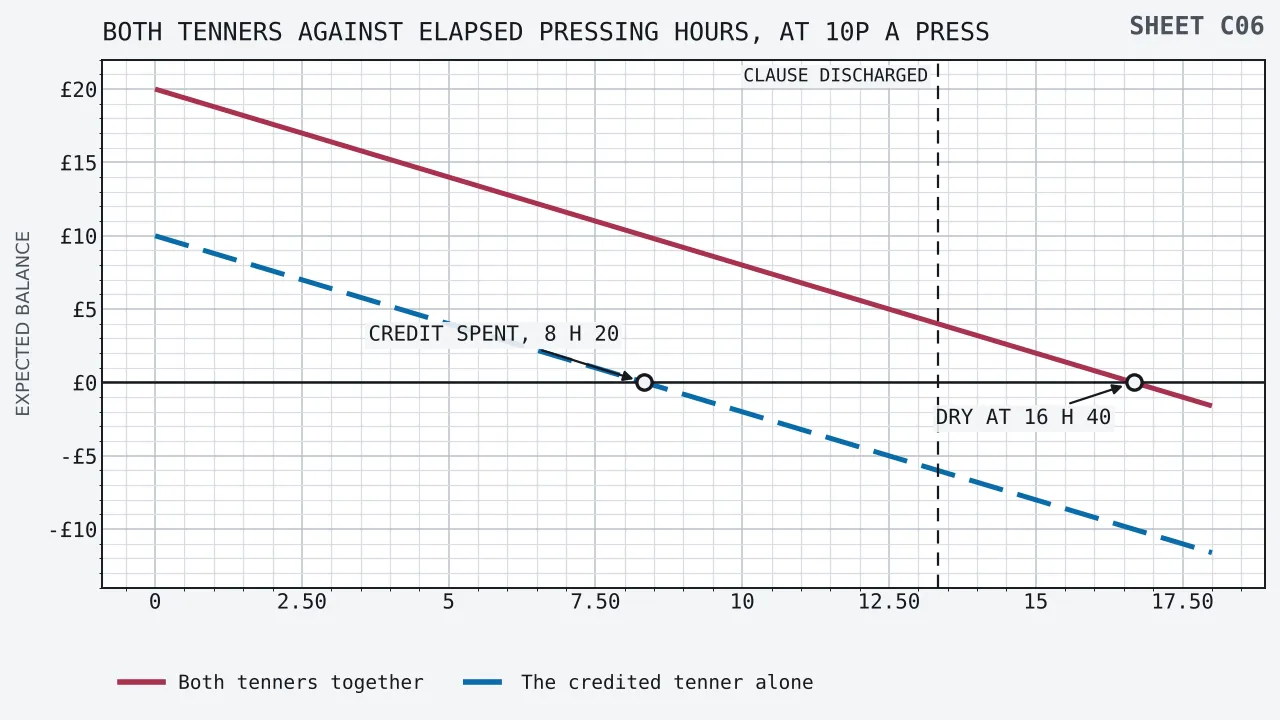
Sixteen hours and forty minutes is where the upper line meets nothing, being £20.00 of account against four pence a pound, 5,000 presses in all on the posited interval. The clause closes 1,000 presses earlier. That ordering is particular to a hundred per cent match and it does not hold one rung up the ladder, which is the plainest reason for pricing each percentage separately rather than scaling one answer.
Four pounds is what the account is expected to hold when press 4,000 is made. Twenty pounds went in between the two parties, £16.00 of expected margin came out across £400.00 of staking, and the remainder is £4.00. A reader who finishes is expected to be looking at four pounds, on an account that read twenty at the start.
4
Two routes to minus six pounds, and why they meet
Minus six pounds is what the house formula returns for a credited tenner at forty times and a ninety-six per cent return. Four hundredths taken forty times is 1.6, so the clause charges a pound and sixty against each pound of credit, the bracket settles at minus 0.6, and a tenner multiplied by it gives minus £6.00.
10.00 × (1 − 40 × 0.04) = minus 6.00
Six pounds is also the arithmetic of the bank statement, arrived at without the formula at all. Ten pounds left an account. Four pounds is expected to be standing when the clause closes. The difference is six, and the two routes agree to the penny because they are the same subtraction performed in a different order.
Nothing is what the match is worth, and the agreement above is the proof of it. If the credited tenner carried any value at all, the two routes would part company: the formula prices the credit alone, the statement prices the whole exercise, and they coincide only where the credit contributes nought. A reader who wants one sentence from this page can have that one.
| Reading the clause | Sum | What the line stands for |
|---|---|---|
| Credit the match is worth at face | £10.00 | The figure the headline prints |
| Margin expected over £400.00 of staking | £16.00 | Four pence in the pound, forty times ten |
| Formula on the credit alone | minus £6.00 | Face less the margin the clause charges |
| Account when press 4,000 is made | £4.00 | Both tenners less the same £16.00 |
| Payment that was sent to get there | £10.00 | The reader’s half, in full |
| Expected position of the reader | minus £6.00 | Four pounds back against ten paid in |
An expectation describes everybody who starts and forecasts nobody’s fortnight. Four thousand results spread widely, a share of readers will close the clause with real money standing, and a larger share will see the account reach nothing early. The average earns its place for one reason only: before press number one it is the sole statistic that exists.
Thirteen hours and twenty minutes is the attention that journey to minus six pounds consumes, on the twelve seconds posited for a press and the twenty-two minutes posited for a sitting. Set beside the figure it arrives at, the hours are the larger quantity by a wide margin, and they are the one quantity no cashier publishes.
5
Seventy-five pence for every hour the clause asks
A thousand pence divided by 13.333 hours gives 75 pence, and that quotient restates the payment as the thing the payment procures. Nobody writes a cheque in that unit, which is exactly why it is worth building. Read forwards, ten pounds buys thirteen hours and twenty minutes of deliberate thumb work at seventy-five pence an hour, the hours being computed from the interval posited here.
Four presses a penny is the same rate read backwards, 4,000 presses over a thousand pence, and at the posited twelve seconds each penny of the payment buys forty-eight seconds of pressing. Spend a pound of it and 400 presses follow, an hour and twenty minutes of them. Size is not the only gap between the payment and the undertaking it signs. The ratio is forty to one, £400.00 of demanded staking set against £10.00 of money that genuinely moved.
48 seconds of pressing bought by each penny paid in
One fortieth is the share of the demanded staking that the payment itself represents, 2.5 per cent, and the fraction is worth carrying into any cashier page presenting a payment as the key to a package. What the key opens is a requirement, and the requirement is counted in presses while the payment is counted in pence.
One pound of credit for one pound paid is the rate the headline quotes, and it is the only ratio published in a shape a reader can verify unaided. Set it against forty-eight seconds of obligation per penny and the two sentences describe one arrangement. The first sounds like a doubling. The second sounds like a job, and the second is the one with the hours in it.
Nought of this changes if a reader presses faster, because the count does not move. Four thousand is fixed by forty times and by the size of one press, so a quicker interval cuts the clock in the same ratio while every sum in pounds stays put. At six seconds a press the tenner buys six hours forty at £1.50 an hour; at twenty seconds it buys twenty-two hours thirteen at 45 pence. Pace decides only how many weeks pass before a reader arrives at a sum the terms had already fixed.
6
Which of the two sums a condition is written over
Three wordings cover nearly everything a reader meets on a matched offer, and which one applies changes the run by a factor of two. No banner carries any of them. They sit together in the clause about qualifying payments, several screens from the clause about withdrawals, and a reader working forwards arrives at them last.
One is forty times the credit by itself. Four hundred pounds of staking, 4,000 presses, 13 h 20 min on the posited interval, 37 sittings at the posited length. The payment is not staked by the clause, although it is spent by the pressing once the credited half has been eaten through, and under the mildest wording it can be asked for back before the clause is attempted at all.
Two is the payment sent over the reels once before the credit unlocks. Ten pounds of staking joins the £400.00, taking the demand to £410.00, 4,100 presses and 13 h 40 min, which is 38 sittings. Forty pence of expected margin and twenty further minutes is the whole of the addition, which leaves this the mildest of the three and the wording a reader should hope to meet.
Three is both tenners put under the same forty, and here the character of the thing changes. Forty applied to £20.00 demands £800.00 across the reels, which is 8,000 presses and 26 h 40 min on the posited interval, or 73 sittings. Thirty-two pounds of expected margin is charged against an account holding twenty, so the money is expected to be gone at press 5,000 with 3,000 presses still owed.
| How the clause is written | Staking demanded | Presses at 10p | Run on the posited interval | Sittings | Where the payment stands at the close |
|---|---|---|---|---|---|
| Forty times the credited half | £400.00 | 4,000 | 13 h 20 min | 37 | Expected to have carried the closing five hours |
| Payment across once, then the clause | £410.00 | 4,100 | 13 h 40 min | 38 | Forty pence of expected cost on top |
| Both halves under one multiple | £800.00 | 8,000 | 26 h 40 min | 73 | Expected gone three thousand presses early |
Thirteen hours and twenty minutes separates the first row from the last, with the payment, the percentage and the stake identical from top to bottom. One clause in the terms doubles the demand on a reader’s evenings, and it is a clause of a line and a half printed nowhere near the figure it doubles. Nobody holding two matched offers side by side is comparing one object with another until that line has been located in each.
Whether a requirement reaching the payment as well as the credit sits inside the British ceiling on multiples has not been addressed anywhere a reader could look it up. That ceiling is drafted over bonus funds. So the third row above is priced here purely as arithmetic, with no claim entered about how the ceiling would read it, and the silence gets reported rather than filled.
A ceiling on what may be staked while credit is live sits on most term sheets, and it is the reason the clock cannot be compressed by pressing bigger buttons. Four hundred presses at a pound would discharge £400.00 inside an hour and twenty on the posited interval. A single press over that ceiling is the commonest route to a voided balance, and the voiding reaches backwards across everything already pressed.
7
What a licence does to a clause of this shape
A match of this build holds no Great Britain licence, which is to say it is run from somewhere the British register does not reach, and the duties worth naming here bear on the second tenner rather than on the first. Other losses are real and are costed on other notes. These attach to the credit, the terms that define it, and the advertisement that described it, which is the whole subject of this page.
Ten times the credit is as far up as a British licence lets a multiple go. The limit is the third of the four things code 5.1.1 on social responsibility forbids, and since 19 January 2026 it has reached every operating licence except two, the technical sort and the software sort. Ten over a credited tenner asks £100.00 across the reels: 1,000 presses, which is 3 h 20 min on the interval posited here, or ten sittings. Set that beside 13 h 20 min and a licence is worth precisely ten hours of pressing on this one arrangement.
Sixty times is the figure the regulator itself put on current practice when it wrote that ceiling, and no other multiple describing this market reaches the page with a regulator standing behind it. Sixty over a credited tenner comes to £600.00 of staking, 6,000 presses, 20 h on the posited interval. From the ceiling to that figure is 5,000 presses, sixteen hours and forty minutes that a reader either spends or does not, decided by one number in one sentence.
| Multiple over the credit | Staking | Presses | Sittings, posited length | Run, interval as posited | Expected at the close | What fixes the number |
|---|---|---|---|---|---|---|
| Ten | £100.00 | 1,000 | 10 | 3 h 20 min | £6.00 | The ceiling a British licence imposes |
| Twenty-five | £250.00 | 2,500 | 23 | 8 h 20 min | £0.00 | The reciprocal of a four pence margin |
| Forty | £400.00 | 4,000 | 37 | 13 h 20 min | minus £6.00 | The band a cashier out here usually prints |
| Sixty | £600.00 | 6,000 | 55 | 20 h | minus £14.00 | The practice the ceiling was written against |
A rule commencing alongside it bars any single incentive from reaching across more than one product type, and it lists four: betting, casino, bingo, lottery. Free spins alongside a match stay within the casino entry, reels being a casino product, so that pair is buildable under a licence. Bingo tickets alongside a match take in two entries at once and are not. Reading the list that way tells somebody which packages a licensed cashier is unable to assemble at all.
Clear, transparent and fair terms, made easy to reach by anybody the incentive is offered to, is the first thing the same code provision demands of any inducement. Alongside it the advertising rules name the conditions that must be prominent, and the list reads like the small print of a match: who may claim, what must be paid in, what must be wagered, and when the clock runs out. Nothing in that list is optional on a licensed advertisement and nothing in it binds an unlicensed one.
Nought of the above reaches a cashier that holds no British licence. What a reader gives up on this subject is the ceiling, the product rule, the transparency duty and the prominence duty together, which is the entire apparatus governing what the second tenner may be made to cost. The arithmetic of the clause remains exactly as computed above, and the difference is that nobody is obliged to keep the number small.
8
Who a matched tenner genuinely suits
Twenty pounds of playable funds for ten pounds paid is a real doubling of the pressing a payment buys, and nothing above disputes it. Somebody who wanted an evening of reels gets two evenings for the price of one, and the second evening costs the reader nothing because the margin on it is met out of money the cashier typed in.
Thirteen hours and twenty minutes is what comes back the other way, and no reasonable accounting puts the two on one scale. Thirty-seven sittings at the posited length, 4,000 deliberate presses, better than three working days of attention, set against a credited sum of ten pounds which the clause is expected to eat through and overshoot by six.
One kind of reader is untouched by any of it. Somebody who intends to press a few hundred times, enjoys the pressing itself and never means to attempt the clause has bought more reels for their tenner than an unmatched payment would buy. Where the terms allow the payment to be asked for back before the credit is touched, that reader can take the extra pressing and leave the obligation alone. Everything else on this page is written for a different reader.
Four questions settle it for everybody else, and on a matched offer they have to be put in this sequence. Which of the two sums the multiple is written over, since pooling them doubles the run to 26 h 40 min. What the multiple is, twenty-five being where a credit stops being worth chasing. What the window is. And what ceiling sits on a single stake, since that figure decides how much of the clock can be squeezed out.
Seventy-five pence an hour is where this note has been heading since its first line. Nobody sending a tenner to a cashier pictures the act as a purchase of 13.333 hours of thumb work at that rate, and a purchase of exactly that is what it is. It survives any sensible change of assumption, because a faster press moves the price per hour and not one of the 4,000 presses that have to be made.
Questions
- How long does a 100% deposit bonus take to clear on a £10 payment?
- Thirteen hours and twenty minutes of pressing. Forty times a credited tenner comes to £400.00 crossing the reels, and ten pence at a time that is 4,000 presses. At the twelve seconds this note posits for one, they occupy 48,000 seconds. Against a sitting posited at twenty-two minutes it is 37 separate times a handset comes out. Both the interval and the sitting are conventions adopted for modelling and neither was measured.
- Is the matched money the same as my own money once it lands?
- No, and the account total hides the difference. The payment came from a bank, and until a reel takes it the reader may in principle ask for it again. The credit was typed in by the party that wrote the terms, cannot be asked for at all, and carries a clause of £400.00. The two sums are equal in size and agree on nothing else, so adding them produces a figure that cannot be spent or withdrawn.
- What is a hundred per cent match actually worth?
- Nothing, and two separate sums prove it. The house formula gives a credited tenner at forty times and a ninety-six per cent return as minus £6.00. The bank statement gives the same thing: ten pounds went out, £4.00 is expected to be standing when press 4,000 is made, and the difference is six pounds. Agreement to the penny between the two is possible only where the credited half adds nought.
- Does the deposit have to be played through too, or only the bonus?
- That turns on one line in the terms and the three usual wordings differ by a factor of two. Forty times the credit alone is £400.00, which is 4,000 presses, or 13 h 20 min on the posited interval. The payment sent across once first adds £10.00 of staking, which is forty pence of expected margin and twenty more minutes. Both halves under one multiple demands £800.00, which is 8,000 presses and 26 h 40 min, and the account is expected to be empty at press 5,000 with 3,000 still owed.
- Why does twenty-five keep deciding things on a match?
- Because twenty-five is what a four per cent margin inverts to, and at that multiple a credit is expected to have paid for itself entirely. A credited tenner funds 2,500 presses of margin, which is 8 h 20 min on the interval posited here. Forty times asks 4,000 presses, so the last 1,500 of them, five hours of pressing, have to be paid for out of the money the reader sent from a bank.
- How much of this would a British licence have taken off?
- The multiple, and with it ten hours of pressing. Ten is as high as a multiple over bonus funds may go, set by code 5.1.1 on social responsibility and in force since 19 January 2026. Ten over a credited tenner is £100.00 of staking, 1,000 presses, 3 h 20 min on the posited interval. A match of this build holds no Great Britain licence, so the ceiling, the ban on mixing product types inside one incentive, the duty to write transparent terms and the duty to make significant conditions prominent are all absent at once.
- Can the thirteen hours be shortened by staking more than ten pence?
- Only as far as the ceiling on a single stake allows, and that ceiling is on most term sheets precisely because the compression would otherwise work. Four hundred presses at a pound would discharge £400.00 in an hour and twenty on the posited interval. A bigger stake cuts the clock by the same ratio, moves the expected outcome not at all, and widens the swing, so the account hits nothing early a good deal more often. Going over the ceiling voids balances after the fact.
- Is a hundred per cent match worth taking at all?
- The doubled pressing is worth having and the clause is not. Somebody who wanted an evening of reels gets a second evening funded by the cashier, and if the terms let the payment be asked for back before the credit is touched, they can stop there. Treating the credit as a sum to extract means 37 sittings, 4,000 presses and an expected minus £6.00, which values the payment at seventy-five pence against each hour of obligation it purchased.