Note W08 Revision 1 Terms read 17 October 2026
100 free welcome bonus no deposit required, read two ways and priced both
A hundred what. The phrase withholds the noun, and the two things it could mean are a hundred presses and a hundred pounds. One comes to £384.00 of staking and 12 h 48 min on the press interval supposed here; the other comes to £4,000.00 and 133 h 20 min. Five weeks of evenings against fifty-two, from six words that differ by nothing.
If it means presses 12 h 48 min If it means pounds 133 h 20 min Between the two 10.42 to 1
What a joining of this shape asks in minutes
Advertising has been bought for every destination below. A fee reaches this site when a reader goes on to register, and no figure on this page moves one way or the other because of it.
-
01Mobile Free Spins
Betportal
Ceiling as a multiple
What lands€15.00150 spins at 10c, which is this site's figure and not the operator'sThe run17 h 30 minTurning over 525.00 at 10p means 5,250 presses, or about 48 phone sittings of 22 minutes. Timed at 10p a press and 12 seconds between presses, both of which this site assumes rather than measures.The wait to be paidNOT PUBLISHEDThis operator puts no withdrawal band in its own terms, so there is nothing honest to print here.Spins valued at this site's own 10p a spin
What lands
Spins, at a price15.00150 of them at 10c apiece, a figure belonging to this site rather than to the operatorMatch, and other creditno figure300% of three deposits, to a ceiling of €1,000. Not a sum until money of yours makes it one, so this row totals nothing and carries nothing downwardsThe run
Handed back on the spins(0.60)Each press stakes its own value and returns 96 per cent, which leaves this much with the house from the opening pressPlay-through 35x on the bonus(20.16)Taking 14.40 round 35 times over means 504.00 through the machines, of which 20.16 is the expected cost, and 17 h 30 min of pressing at the pace aboveWhat counts towards it100%Slots only, with no percentage published anywhere, so the row above assumes the whole of each stake countsWhat never clears
Limit on the winningsstated5x the bonusDeducted on the way outno figureNothing is published as a figure here, so this row removes nothingLeast that can leaveno figureNo figure is published, so nothing on this timer is pinned down by oneLeast deposit, and the rung over ityour own€20 a stage. Published in euros, so no rung is named at all: this site's ladder is a sterling oneThe window on the creditstated14 daysBiggest stake while it runsstated€5Removed outright by rulestatedNot publishedVerified before a payoutstatedDocuments before the first withdrawalNever clears€15.00Not a penny of it gets out, so the whole of what landed stands on this rowNo Great Britain licence
Licence held in Anjouan, Comoros, the company named is BetPortal Gaming Ltd, with Excite Ultra Media Ltd, quoted under ALSI-202601040-FI2.
Terms read 17 October 2026
Open the offer at Betportal, opens in a new window -
02Mobile Free Spins
WinBeast
Ceiling as a sum
What lands€50.00500 spins at 10c, which is this site's figure and not the operator'sThe run2 d 18 hTurning over 2,000.00 at 10p means 20,000 presses, or about 182 phone sittings of 22 minutes. Timed at 10p a press and 12 seconds between presses, both of which this site assumes rather than measures.The wait to be paidNOT PUBLISHEDThis operator puts no withdrawal band in its own terms, so there is nothing honest to print here.Spins valued at this site's own 10p a spin
What lands
Spins, at a price50.00500 of them at 10c apiece, a figure belonging to this site rather than to the operatorMatch, and other creditno figure50% to 100% of five deposits, each to a ceiling of €1,000, and a €650 free bet. Not a sum until money of yours makes it one, so this row totals nothing and carries nothing downwardsThe run
Handed back on the spins(2.00)Each press stakes its own value and returns 96 per cent, which leaves this much with the house from the opening pressPlay-through 40x on the bonus and the winnings from the spins(76.80)Taking 48.00 round 40 times over means 1,920.00 through the machines, of which 76.80 is the expected cost, and 2 d 18 h of pressing at the pace aboveWhat counts towards it100%Slots, titles vary by country, with no percentage published anywhere, so the row above assumes the whole of each stake countsWhat never clears
Limit on the winningsstated€100 a batch of spinsDeducted on the way outno figureNothing is published as a figure here, so this row removes nothingLeast that can leaveno figureNo figure is published, so nothing on this timer is pinned down by oneLeast deposit, and the rung over ityour own€20 a stage. Published in euros, so no rung is named at all: this site's ladder is a sterling oneThe window on the creditstated7 days, spins 1 dayBiggest stake while it runsstatedNot publishedRemoved outright by rulestatedNot publishedVerified before a payoutstatedDocuments before the first withdrawalNever clears€50.00Not a penny of it gets out, so the whole of what landed stands on this rowNo Great Britain licence
Licence held in Curaçao, no company named anywhere on the site.
Terms read 17 October 2026
Open the offer at WinBeast, opens in a new window -
03Mobile Free Spins
EliteSpin
Longest spin window
What lands£50.00500 spins at 10p, which is this site's figure and not the operator'sThe run2 d 18 hTurning over 2,000.00 at 10p means 20,000 presses, or about 182 phone sittings of 22 minutes. Timed at 10p a press and 12 seconds between presses, both of which this site assumes rather than measures.The wait to be paidNOT PUBLISHEDThis operator puts no withdrawal band in its own terms, so there is nothing honest to print here.Spins valued at this site's own 10p a spin
What lands
Spins, at a price50.00500 of them at 10p apiece, a figure belonging to this site rather than to the operatorMatch, and other creditno figure50% to 100% of five deposits, each to a ceiling of £1,000. Not a sum until money of yours makes it one, so this row totals nothing and carries nothing downwardsThe run
Handed back on the spins(2.00)Each press stakes its own value and returns 96 per cent, which leaves this much with the house from the opening pressPlay-through 40x on the bonus and the winnings from the spins(76.80)Taking 48.00 round 40 times over means 1,920.00 through the machines, of which 76.80 is the expected cost, and 2 d 18 h of pressing at the pace aboveWhat counts towards it100%Slots, with no percentage published anywhere, so the row above assumes the whole of each stake countsWhat never clears
Limit on the winningsstated5x the bonusDeducted on the way outno figureNothing is published as a figure here, so this row removes nothingLeast that can leaveno figureNo figure is published, so nothing on this timer is pinned down by oneLeast deposit, and the rung over ityour own£20 a stage. It lands square on the £20.00 rung, so none of yours is left perched on topThe window on the creditstated7 days, spins 3 daysBiggest stake while it runsstatedNot publishedRemoved outright by rulestatedNot publishedVerified before a payoutstatedDocuments before the first withdrawalNever clears£50.00Not a penny of it gets out, so the whole of what landed stands on this rowNo Great Britain licence
Licence held in Costa Rica, the company named is PrimeTier Limited.
Terms read 17 October 2026
Open the offer at EliteSpin, opens in a new window -
04Mobile Free Spins
Crown Jewelz
Multiple unpublished
What lands£15.00150 spins at 10p, which is this site's figure and not the operator'sThe runNOT TIMEDThis operator does not publish the play-through multiple in its own terms. The multiple is the one figure the clock cannot work around, so the run is left untimed.The wait to be paidNOT PUBLISHEDThis operator puts no withdrawal band in its own terms, so there is nothing honest to print here.Nothing reckoned
What lands
Spins, at a price15.00150 of them at 10p apiece, a figure belonging to this site rather than to the operatorMatch, and other creditno figure200% of the first deposit, then 150% twice, each to a ceiling of £1,000. Not a sum until money of yours makes it one, so this row totals nothing and carries nothing downwardsThe run
Play-throughno figure40x the bonus, reported rather than published by the operatorWhat counts towards itno figureSlots, with no percentage published anywhere, so the row above assumes the whole of each stake countsWhat never clears
Limit on the winningsstatedNot publishedDeducted on the way outno figureNothing is published as a figure here, so this row removes nothingLeast that can leaveno figureNo figure is published, so nothing on this timer is pinned down by oneLeast deposit, and the rung over ityour own£20. It lands square on the £20.00 rung, so none of yours is left perched on topThe window on the creditstatedNot publishedBiggest stake while it runsstatedNot publishedRemoved outright by rulestatedNot publishedVerified before a payoutstatedDocuments before the first withdrawalNever clearsNOT RECKONEDThis operator leaves the play-through multiple out of its own terms, so nothing below the fourth step can be worked out.No Great Britain licence
Licence held in Curaçao, number not verified, no company named anywhere on the site.
Terms read 17 October 2026
Open the offer at Crown Jewelz, opens in a new window
Only the middle reading comes out of arithmetic belonging to this site. The multiple laid against what lands gives the turnover asked for; dividing that by 10p a spin gives the presses; dividing those by 300 an hour gives the hours, a press on a handset being taken here at 12 seconds from the one before. Both figures are assumptions rather than measurements of anybody: nothing was played and nothing was held a stopwatch to. Anybody quicker should divide the press count by a rate of their own, which is why the presses are printed alongside the hours instead of being summarised away.
The first reading is what arrives before any condition is laid against it. Spins carry no unit of their own so one gets supplied: where an operator values its own spin that figure is used and attributed, and where it does not, this site's 10p a spin stands in and everything below moves with it. The third reading belongs to the operator entirely. It is a withdrawal band quoted from published terms, and a blank there means none was published rather than that nobody looked.
The total along the foot answers what the hours leave open, which is whether any of the running ends anywhere. It is what arrived, less whatever is still standing once the play-through has been paid for at 96 per cent return to player and once a published limit, a published deduction and a published floor beneath the least that can leave have each had a turn. It appears again in pence in the pound, the only fair way of holding a small offer up against a large one. It describes an offer rather than an evening, and where the conditions price out what arrived, a timer prints nothing getting out instead of a negative sum.
Cashiers on a handset take deposits off a row of preset buttons, so a least deposit given in pounds is raised to the next rung of the ladder used here, £10, £20, £25, £50, £75 and £100, and the timer shows what is left perched on it. That money is the reader's own and enters no sum at all. Given in euros it prints untouched, the ladder being sterling. Three words may occupy the figure column where no figure belongs. Stated is a published term that costs something while leaving no number to subtract. No figure is a term nobody has quantified, or a credit that is not a sum until money of yours makes it one. Your own is money of yours, which belongs in none of this.
None of the operators above is licensed in Great Britain, so not one duty that licence carries reaches any of them. Membership of Gamstop Online is compulsory for every online gambling company licensed in Great Britain, which means that shutting yourself out through the scheme shuts you out of none of these. The limit of ten times the bonus funds on a wagering requirement, running since 19 January 2026 under Social Responsibility Code 5.1.1, is a condition of the same licence and binds only whoever holds one. Off that licence, the Gambling Commission writes of consumers meeting unfair gaming practices, financial loss and no recourse when matters go wrong, and lists blocked payouts and withdrawal limits pitched too high to reach among the things it has seen. No account at any of them may be held by anybody under 18.
Every term on a timer is its operator's own and every timer carries the day somebody read it. The oldest of those readings is 17 October 2026. What binds a reader is an operator's full terms and never a line printed here.
1
The word that went missing, and what it would have settled
A hundred what. That is the question the phrase declines to answer, and it is not a quibble about grammar. Searches for 100 free welcome bonus no deposit required return two entirely different products, because a hundred free can mean a hundred presses of a reel or a hundred pounds in a bonus balance, and the two are separated by an order of magnitude in every figure this note is able to compute.
Three nouns could occupy the empty slot and only one of them is ruled out by the rest of the phrase. Presses is the first. Pounds is the second. Per cent is the third, meaning a match of a hundred per cent on money paid in, and that reading dies on the words no deposit required, because a percentage needs a payment to be a percentage of. Four of the six words therefore do exactly one piece of disambiguation between them, and it is not the piece a reader needs.
Ten pence a press is the stake held fixed throughout this note, declared as a convention rather than discovered, since no published British requirement puts a pence value on one free press at all. The other inputs are a return of 96 per cent, a condition at forty times, and a press supposed to take twelve seconds. Nothing here was timed. The interval is a supposition, and every duration below is divided out of it.
Two complete workings follow, one for each surviving noun, and they are run side by side rather than one being treated as the likely case. Guessing which was meant is precisely the job this note refuses to do for a reader, because the guess is worth 120 hours and 32 minutes of pressing on the interval supposed below and nobody should be making it from a headline.
Nothing across these ten parts assists anybody past a check on age, past a check on who an account belongs to, or past a bar a person has put over their own play, and the refusal holds whatever the reading. Giving a cashier another person’s details is fraud. A gambling block set by a bank is a protection in the same sense, and so is Gamstop Online, which covers accounts holding a British licence and therefore covers none of what this page prices.
2
Taking it as a hundred presses, carried all the way out
Ten pounds is what a hundred presses puts across the reels at the stake this note holds fixed, and £9.60 is the average coming back where the return stands at 96 per cent. Twenty minutes is how long a hundred presses occupy where each is supposed to take twelve seconds, which is just under one pick-up of a handset against a sitting supposed to run twenty-two minutes.
Three hundred and eighty-four pounds is where the condition lands, forty multiplied by the £9.60 the presses are expected to leave standing. Three thousand eight hundred and forty presses is that sum divided into ten-pence pieces, occupying 12 h 48 min at the supposed interval, and 35 pick-ups is the identical span measured against the supposed sitting, with the fraction carried upward because an evening cannot be nine-tenths attended.
3,840 presses demanded by twenty supposed minutes of play
Minus five pounds seventy-six is where that reading is expected to finish. A condition at forty times, run against a margin of four pence in the pound, consumes 160 pence for every hundred credited, so a £9.60 face ends at minus £5.76 on average. The twenty advertised minutes buy 768 minutes of obligation, both quantities resting on the supposed interval, which puts the two at 38.4 to one, a proportion any count of presses would reproduce on these inputs.
One pick-up against thirty-five is the comparison in its bluntest form. The part of this reading a banner describes fits inside a single evening and the part it does not describes five weeks of them. Both halves rest on a press supposed to take twelve seconds and on a sitting supposed to run twenty-two minutes, neither of which was observed anywhere.
3
Taking it as a hundred pounds, carried all the way out
A hundred pounds arrives as a balance rather than as a count, and that single structural difference is what makes the second reading a different product rather than a bigger version of the first. Nothing has to be spent before the condition attaches. The condition fastens on the credited figure itself, which is £100.00 and not an expected return out of staking.
Four thousand pounds is what forty times that credit demands across the reels, and the multiplication is the whole of the derivation. Forty thousand presses of ten pence is the same demand in the unit this note counts in. Those presses occupy 133 h 20 min where each is supposed to take twelve seconds, and 364 pick-ups is the identical span against the supposed sitting of twenty-two minutes, carried upward from 363.6.
| Quantity | A hundred presses | A hundred pounds | What the gap is made of |
|---|---|---|---|
| What the condition fastens on | £9.60 | £100.00 | An expected return against a credited sum |
| Staking demanded at forty times | £384.00 | £4,000.00 | The same multiple on a base ten times apart |
| Presses of 10p that comes to | 3,840 | 40,000 | Proportional throughout |
| Time at the supposed interval | 12 h 48 min | 133 h 20 min | Twelve seconds a press, supposed not counted |
| Pick-ups of a handset, rounded up | 35 | 364 | Twenty-two minutes a sitting, supposed not counted |
| Expected at the end | minus £5.76 | minus £60.00 | A margin of four pence carried forty times over |
Minus sixty pounds is where the second reading is expected to end, the same 160 pence of consumption for every hundred credited, applied to a credit of a hundred. That is the largest expected loss this site has cause to compute on anything described as costing nothing, and it arrives out of a promotion whose headline is six words long and contains no pound sign.
Five and a half days is 133 hours and twenty minutes read as continuous time, which nobody would attempt and which is worth stating anyway because it fixes the scale. Pressing a reel without pause from Monday morning to Saturday afternoon is what the second reading’s condition asks, at an interval supposed throughout and measured nowhere.
4
Ten point four two to one, and the four pence inside it
Ten point four one six is the ratio between the two readings, and it recurs in every row of the table above because the two workings differ only in their base. Four thousand divided by three hundred and eighty-four gives it. So does 8,000 minutes divided by 768. So does £100.00 divided by £9.60.
Ten would be the answer if the counts alone were in question, since a hundred presses of ten pence puts ten pounds across the reels and a hundred pounds is a hundred pounds. The extra 0.4166 has one source. In the first reading the condition fastens not on the £10.00 staked but on the £9.60 expected back from it, and 10 divided by 0.96 gives 10.4166. Four pence in the pound is the entire discrepancy.
10.42 to one between two readings of the same six words
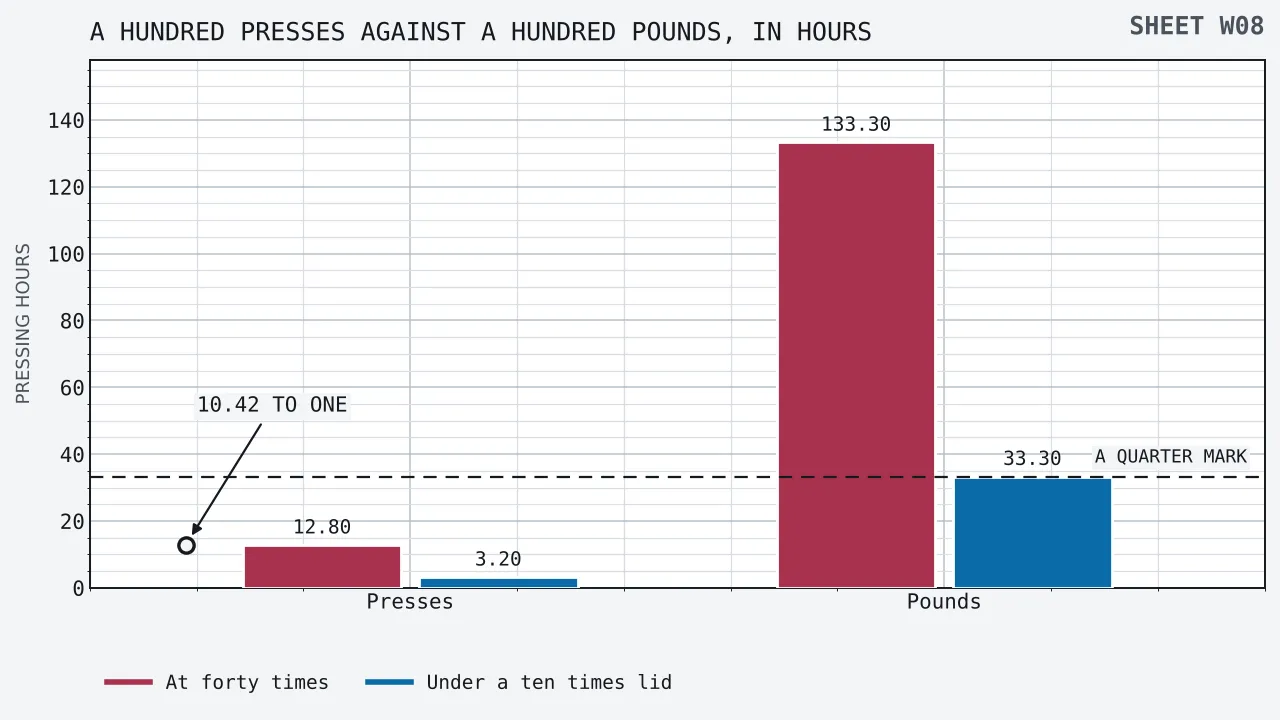
Nothing holds that ratio in place, which is the uncomfortable other half of the arithmetic. The 10.42 survives only while a press is worth ten pence. Put a press at 20p and the first reading’s base doubles to £19.20 and its demand doubles to £768.00, which is 25 h 36 min at the supposed interval, and the distance between the two readings closes to 5.21 to one. Put it at 5p and the distance opens out to 20.83. A credit of a hundred pounds is untouched by any of that, because a sum needs no per-press value in order to be a sum.
One hundred and twenty hours and thirty-two minutes is the absolute distance between the two readings, 133 h 20 min less 12 h 48 min, at the interval supposed here. That is the quantity a reader is being asked to guess at from a headline. No other page on this site prices a single missing word so highly, and the word in question is one syllable long.
5
Five weeks of evenings against fifty-two of them
Thirty-five pick-ups and 364 pick-ups are the two readings put into the unit a reader actually spends, each worked against a sitting supposed to run twenty-two minutes and each rounded upward from a fraction. Both figures happen to divide cleanly by seven, which makes them unusually easy to hold in the head.
Five weeks is what 35 evenings comes to at one sitting a night. Fifty-two weeks is what 364 comes to on the same footing, which is a calendar year less a day. A promotion whose headline reads identically in both cases is therefore asking either for the stretch between now and the middle of next month, or for the stretch between now and this date next year.
| At one sitting a night | A hundred presses | A hundred pounds |
|---|---|---|
| Pick-ups of a handset, rounded up | 35 | 364 |
| Weeks that comes to | 5 | 52 |
| Minutes the final evening carries | 20 | 14 |
| Expected position at the end | minus £5.76 | minus £60.00 |
Fourteen minutes is all the 364th evening carries, since 363 full sittings of a supposed twenty-two cover 7,986 minutes against a demand of 8,000. A reader who treats that last evening as optional has cleared nothing whatever, because a condition left fourteen minutes short pays what a condition never begun pays, and both pay nought.
Nothing in either column can be shortened by pressing more briskly, and the reason is the press count rather than the cadence. Spreading 40,000 presses over a year of single sittings already assumes 364 of them get found. Fitting the same count into one waking day of sixteen hours calls for a press every 1.44 seconds held up without a break, and no slot answering to a British licence is allowed to turn over that fast.
6
The words beside the number that settle which offer it is
Six tells exist and each is a matter of logic rather than of market habit, which is why they can be relied on. Every one of them concerns what sits immediately beside the figure, and together they will resolve most banners in the time it takes to read one.
| What appears | Which reading it settles | Why it settles it |
|---|---|---|
| A currency sign fixed to the figure | Pounds | The sign is the unit, and a count of presses has no sign to carry |
| A counting noun straight after it, such as spins, rounds or games | Presses | The noun supplies the unit the number was missing |
| A percentage sign | Neither, and the offer is a match | A percentage has to be a percentage of a payment, which these words exclude |
| A per-press value, such as a figure in pence attached to each one | Presses, and it fixes the face | Only a count of presses needs a value assigned to each press |
| A multiple quoted with no pound figure printed anywhere | Presses | A multiple needs a base, and with no sum published the base must be what the presses return |
| A maximum conversion or a win cap in pounds | Nothing on its own | Both readings can carry a cap, so the figure settles the ceiling and not the credit |
Five of those rows decide the question outright and the sixth is included because it looks as though it should and does not. A pound figure appearing somewhere in the terms is not evidence that the credit is a pound figure, since a cap on what a win converts to is a separate quantity from the credit it caps, and the two can sit in the same paragraph without either explaining the other.
One tell is worth stating twice, being the tell most often to hand. If a multiple is printed and no sum is printed, the credit is a count. A condition cannot multiply a number that has not been given, so the base is being generated somewhere, and the only thing on the banner capable of generating it is the presses. On the figures used here that distinction is worth 120 hours and 32 minutes at the supposed interval.
7
What the other four words do and do not eliminate
Welcome places the offer and sizes nothing. It says the credit belongs at the opening of an account rather than part way through one, which is useful for knowing when to expect it and useless for knowing how large it is. Both readings are equally welcome offers, and the word appears in both without strain.
Four words at the tail do more work, and the work is narrow. No deposit required settles that nothing has to be paid in first, which disposes of the percentage reading entirely, since a match is a proportion of a payment and there is no payment. What the tail words leave standing is precisely the pair this note has been pricing, and they do not choose between them.
| The words | What they fix | What they leave open |
|---|---|---|
| 100 | A magnitude | Its unit, which is the whole question |
| free | That qualifying costs no stake of the reader’s own | Everything owed after qualifying |
| welcome | When the credit arrives | How large it is |
| bonus | That a condition is likely attached | The multiple and the base it runs on |
| no deposit required | That the percentage reading is out | Presses against pounds |
Nought of those rows is a criticism of any particular wording, and the table is an analysis of a search phrase rather than of a promotion. What it shows is that a reader typing these six words has already specified five things and has not specified the one that moves the answer by a factor of ten. That is a property of the phrase itself, and it survives whoever is answering it.
One word in the phrase is narrowly accurate and worth crediting. Qualifying genuinely costs no stake of the reader’s own under either reading, which is the test the advertising regulator applies to the description, and under both readings it passes. The word then falls silent about 3,840 presses in one case and 40,000 in the other.
8
A ceiling shrinks both readings and resolves neither
Ten times the credited funds is the heaviest condition a British licence permits, a limit the social responsibility code has imposed since 19 January 2026 over remote casino licensing as a whole. Applied to the first reading it cuts £384.00 back to £96.00, a demand of 960 presses occupying 3 h 12 min at the supposed interval. Applied to the second it cuts £4,000.00 back to £1,000.00, a demand of 10,000 presses occupying 33 h 20 min on the same supposition.
| Under a ten times lid | A hundred presses | A hundred pounds |
|---|---|---|
| Staking demanded | £96.00 | £1,000.00 |
| Presses of 10p | 960 | 10,000 |
| Time at the supposed interval | 3 h 12 min | 33 h 20 min |
| Pick-ups, rounded up | 9 | 91 |
| Expected at the end | £5.76 | £60.00 |
Ten point four two is still the ratio between those two columns, and that is the honest and slightly deflating finding of this part. A lid scales both readings by the identical quarter, so it takes 100 supposed hours out of the worse one and leaves the ambiguity precisely as large in proportion as it was. What a ceiling fixes is the size of a condition. It does not fix the meaning of a word.
Both signs reverse underneath the lid, which is the other thing it does. Ten times a margin of four pence in the pound consumes 40 pence of each pound credited and leaves sixty, so the expected answers become plus £5.76 and plus £60.00 against minus £5.76 and minus £60.00. Twenty-five times is the multiple where the sign turns over, since a margin of four pence repeated twenty-five times has swallowed a credit whole, and forty is well past it.
Three months is roughly all the lid leaves of the second reading, 91 evenings standing in place of 364 at a sitting supposed to run twenty-two minutes, which is 273 evenings removed and 100 hours of pressing with them. Nine evenings in place of 35 is the equivalent on the first. Those two reductions are what a British licence is worth on this one phrase, and nobody joining a promotion written outside it collects either.
9
Where a missing noun stops being somebody’s problem
Outside the British licence is where a promotion of this shape operates, and on a page about an ambiguous phrase what goes missing is the entire apparatus treating wording as a regulated object rather than as a matter of taste. A British licensee’s incentive has to satisfy three tests at once in its terms, clarity, transparency and fairness, with those terms kept where the person offered them can get at them. A headline withholding its own unit sits badly against the first of the three.
Two further duties govern presentation instead of payment, and both land on a missing noun. Where leaving a condition out would mislead, the condition belongs next to the headline and not somewhere past it. Prominence, meanwhile, is a question of substance: the British regulator takes an advertisement that has not pushed its significant terms far enough forward to be misleading on that ground alone, which turns the layout of a banner into compliance work rather than design work.
Two findings and a penalty sit on the public record about bonus wording on the licensed side, the penalty running to £170,000 and the date being 3 July 2025. What drew it was a term an operator kept in its rules for new casino promotions, a clause reserving to the business a discretion over shutting an account or taking winnings back. The finding was a breach of the licence condition requiring fairness and openness, and the regulator’s verdict on clauses built that way was that transparency is missing from them and outcomes unfair to consumers may follow. All of it is published, and none of it reaches a business with no licence capable of being breached.
Nought entry exists to look the wording up against, which is the quieter half of the same loss. A reader meeting an ambiguous banner under a British licence can follow the licensed status through to a public register and read the permitted activities and the domain names there. Off the register that route ends immediately, so a phrase that will not say what it means is also a phrase nobody can be made to explain.
Eight weeks is the outer wall a British licensee’s own complaints process runs to, with escalation to an adjudicator the regulator has approved. A dispute about which of two readings was promised is exactly the sort of dispute that wall exists for, and it is worth setting against the 364 evenings the worse reading asks. Out here the route is whatever an operator has drafted, including, where a rulebook permits it, a minimum value below which a claim is not eligible to be escalated at all.
10
Settling the reading in the time it takes to read the line
First look for a sign or a noun. A currency sign fixed to the figure makes it pounds; a counting noun directly after it makes it presses. Where one of those two is present the question is closed before any arithmetic starts, and the rest of this page becomes a lookup rather than an investigation.
Second look for a multiple standing alone. A condition quoted at forty times with no sum anywhere on the banner means the sum is being produced by the presses, which makes the reading a count. That is the single most useful tell available, because a multiple is the one term a promotion of this shape nearly always prints.
Third, work the one that is left. A hundred presses at ten pence runs £10.00 across the reels, returns an expected £9.60, and sets up £384.00 of staking, 3,840 presses, 12 h 48 min at the supposed interval and 35 evenings. A hundred pounds of credit sets up £4,000.00, 40,000 presses, 133 h 20 min and 364 evenings on the same supposition. One is five weeks. The other is a year.
Minus five pounds seventy-six against minus sixty pounds is the pair of expected answers at the end of those two roads, and neither is a figure anybody would reach by reading the headline. Six words, one of them missing, and a difference of 120 hours and 32 minutes of pressing on an interval this note supposes and did not measure. The arithmetic is simple. It is the noun that is doing all the damage.
Questions
- A hundred free what, exactly?
- The phrase declines to say, which is the problem this page exists for. Both readings are ordinary products. A hundred presses of ten pence puts £10.00 across the reels and returns an expected £9.60. A hundred pounds arrives instead as a balance of £100.00. Everything downstream of those two figures differs by a factor of 10.42.
- How can a reader tell which one a banner is offering?
- By what stands next to the figure. A currency sign fixed to it makes it pounds. A counting noun directly after it, such as spins or rounds or games, makes it presses. A multiple quoted with no sum printed anywhere also makes it presses, because a condition has to multiply something and the only available base is what the presses return.
- What does the hundred presses reading cost in hours?
- Twelve hours and forty-eight minutes at the keypad, on a press supposed to take twelve seconds and nothing timed anywhere. A forty times condition on the expected £9.60 demands £384.00 of staking, which comes to 3,840 presses. Against a sitting supposed to run twenty-two minutes that is 35 pick-ups of a handset, or five weeks at one a night.
- What does the hundred pounds reading cost in hours?
- 133 h 20 min, at the same supposed interval. Forty times £100.00 demands £4,000.00 of staking, which divides into 40,000 presses of ten pence. Measured against the supposed sitting that is 364 pick-ups of a handset, or fifty-two weeks at one a night, which is a calendar year less a day.
- Why is the gap 10.42 rather than a clean ten?
- Because of where the condition fastens. Staking of £10.00 is what the first reading puts across the reels, but the condition attaches to the £9.60 those presses are expected to return rather than to the sum put through them. Ten divided by 0.96 gives 10.4166, so the four pence a game retains out of every pound is the entire source of the extra.
- Could 100 free mean a hundred per cent?
- Not alongside these words. A percentage match is a proportion of money paid in, and no deposit required says that nothing is being paid in. That is the one piece of disambiguation the phrase performs, and it rules out the reading a reader was least likely to have meant while leaving the two that differ by 120 hours and 32 minutes.
- Where is each reading expected to finish?
- Minus £5.76 and minus £60.00. A condition at forty times, run against a margin of four pence in the pound, consumes 160 pence for every hundred credited, so a £9.60 base and a £100.00 base finish at those two figures on average. Twenty-five times is the multiple where the sign turns over, a margin of four pence repeated that many times having swallowed a credit whole.
- Would a British licence make the wording any clearer?
- It would bring duties about wording that otherwise do not apply. An incentive’s terms must come out clear, transparent and fair all three together, and must sit within reach of whoever was offered them. Where leaving a condition out would mislead, the condition belongs next to the headline, and an advertisement that has not pushed its significant terms far enough forward is taken by the British regulator to be misleading on that ground.
- Does the ten times cap fix the ambiguity?
- It does not, and the point is worth making plainly. A lid of ten times the credited funds, imposed by the social responsibility code since 19 January 2026, pulls the first reading down to £96.00 and 3 h 12 min and the second to £1,000.00 and 33 h 20 min, both durations resting on the supposed interval. Both shrink by an identical quarter, leaving the distance between them at 10.42 to one. A ceiling settles how large a condition may be. It settles nothing about what a word means.
- Has bonus wording ever drawn a penalty?
- It has. A penalty of £170,000 stands on the public record against a term an operator kept in its rules for new casino promotions, dated 3 July 2025, the clause reserving to the business a discretion over shutting an account or taking winnings back. The finding was a breach of the licence condition requiring fairness and openness, with the regulator saying clauses built that way are missing transparency and may produce outcomes unfair to consumers. A business with no licence has nothing of the sort to breach.
- What should be checked before accepting either version?
- The unit, then the multiple, then the pence behind a press. The unit decides which of the two products is on offer. The multiple decides whether the expected answer sits above nothing or below it. The stake decides how many presses the staking divides into, and therefore how many evenings it occupies at an interval this note supposes rather than measures.