Note B06 Revision 1 Terms read 17 October 2026
100 free spins no deposit, counted in minutes rather than in spins
The hundred presses themselves take twenty minutes. The play-through they set up takes 12 h 48 min at the same pace, which is thirty-five sittings with a phone in your hand, and at forty times the sum those sittings are chasing has already been priced away. This page works the clock rather than the count.
What lands 20 min The run 12 h 48 min The wait to be paid 48 h band
What offers of this size ask in hours
Advertising has been bought for every destination below. A fee reaches this site when a reader goes on to register, and no figure on this page moves one way or the other because of it.
-
01Mobile Free Spins
Betportal
Ceiling as a multiple
What lands€15.00150 spins at 10c, which is this site's figure and not the operator'sThe run17 h 30 minTurning over 525.00 at 10p means 5,250 presses, or about 48 phone sittings of 22 minutes. Timed at 10p a press and 12 seconds between presses, both of which this site assumes rather than measures.The wait to be paidNOT PUBLISHEDThis operator puts no withdrawal band in its own terms, so there is nothing honest to print here.Spins valued at this site's own 10p a spin
What lands
Spins, at a price15.00150 of them at 10c apiece, a figure belonging to this site rather than to the operatorMatch, and other creditno figure300% of three deposits, to a ceiling of €1,000. Not a sum until money of yours makes it one, so this row totals nothing and carries nothing downwardsThe run
Handed back on the spins(0.60)Each press stakes its own value and returns 96 per cent, which leaves this much with the house from the opening pressPlay-through 35x on the bonus(20.16)Taking 14.40 round 35 times over means 504.00 through the machines, of which 20.16 is the expected cost, and 17 h 30 min of pressing at the pace aboveWhat counts towards it100%Slots only, with no percentage published anywhere, so the row above assumes the whole of each stake countsWhat never clears
Limit on the winningsstated5x the bonusDeducted on the way outno figureNothing is published as a figure here, so this row removes nothingLeast that can leaveno figureNo figure is published, so nothing on this timer is pinned down by oneLeast deposit, and the rung over ityour own€20 a stage. Published in euros, so no rung is named at all: this site's ladder is a sterling oneThe window on the creditstated14 daysBiggest stake while it runsstated€5Removed outright by rulestatedNot publishedVerified before a payoutstatedDocuments before the first withdrawalNever clears€15.00Not a penny of it gets out, so the whole of what landed stands on this rowNo Great Britain licence
Licence held in Anjouan, Comoros, the company named is BetPortal Gaming Ltd, with Excite Ultra Media Ltd, quoted under ALSI-202601040-FI2.
Terms read 17 October 2026
Open the offer at Betportal, opens in a new window -
02Mobile Free Spins
WinBeast
Ceiling as a sum
What lands€50.00500 spins at 10c, which is this site's figure and not the operator'sThe run2 d 18 hTurning over 2,000.00 at 10p means 20,000 presses, or about 182 phone sittings of 22 minutes. Timed at 10p a press and 12 seconds between presses, both of which this site assumes rather than measures.The wait to be paidNOT PUBLISHEDThis operator puts no withdrawal band in its own terms, so there is nothing honest to print here.Spins valued at this site's own 10p a spin
What lands
Spins, at a price50.00500 of them at 10c apiece, a figure belonging to this site rather than to the operatorMatch, and other creditno figure50% to 100% of five deposits, each to a ceiling of €1,000, and a €650 free bet. Not a sum until money of yours makes it one, so this row totals nothing and carries nothing downwardsThe run
Handed back on the spins(2.00)Each press stakes its own value and returns 96 per cent, which leaves this much with the house from the opening pressPlay-through 40x on the bonus and the winnings from the spins(76.80)Taking 48.00 round 40 times over means 1,920.00 through the machines, of which 76.80 is the expected cost, and 2 d 18 h of pressing at the pace aboveWhat counts towards it100%Slots, titles vary by country, with no percentage published anywhere, so the row above assumes the whole of each stake countsWhat never clears
Limit on the winningsstated€100 a batch of spinsDeducted on the way outno figureNothing is published as a figure here, so this row removes nothingLeast that can leaveno figureNo figure is published, so nothing on this timer is pinned down by oneLeast deposit, and the rung over ityour own€20 a stage. Published in euros, so no rung is named at all: this site's ladder is a sterling oneThe window on the creditstated7 days, spins 1 dayBiggest stake while it runsstatedNot publishedRemoved outright by rulestatedNot publishedVerified before a payoutstatedDocuments before the first withdrawalNever clears€50.00Not a penny of it gets out, so the whole of what landed stands on this rowNo Great Britain licence
Licence held in Curaçao, no company named anywhere on the site.
Terms read 17 October 2026
Open the offer at WinBeast, opens in a new window -
03Mobile Free Spins
EliteSpin
Longest spin window
What lands£50.00500 spins at 10p, which is this site's figure and not the operator'sThe run2 d 18 hTurning over 2,000.00 at 10p means 20,000 presses, or about 182 phone sittings of 22 minutes. Timed at 10p a press and 12 seconds between presses, both of which this site assumes rather than measures.The wait to be paidNOT PUBLISHEDThis operator puts no withdrawal band in its own terms, so there is nothing honest to print here.Spins valued at this site's own 10p a spin
What lands
Spins, at a price50.00500 of them at 10p apiece, a figure belonging to this site rather than to the operatorMatch, and other creditno figure50% to 100% of five deposits, each to a ceiling of £1,000. Not a sum until money of yours makes it one, so this row totals nothing and carries nothing downwardsThe run
Handed back on the spins(2.00)Each press stakes its own value and returns 96 per cent, which leaves this much with the house from the opening pressPlay-through 40x on the bonus and the winnings from the spins(76.80)Taking 48.00 round 40 times over means 1,920.00 through the machines, of which 76.80 is the expected cost, and 2 d 18 h of pressing at the pace aboveWhat counts towards it100%Slots, with no percentage published anywhere, so the row above assumes the whole of each stake countsWhat never clears
Limit on the winningsstated5x the bonusDeducted on the way outno figureNothing is published as a figure here, so this row removes nothingLeast that can leaveno figureNo figure is published, so nothing on this timer is pinned down by oneLeast deposit, and the rung over ityour own£20 a stage. It lands square on the £20.00 rung, so none of yours is left perched on topThe window on the creditstated7 days, spins 3 daysBiggest stake while it runsstatedNot publishedRemoved outright by rulestatedNot publishedVerified before a payoutstatedDocuments before the first withdrawalNever clears£50.00Not a penny of it gets out, so the whole of what landed stands on this rowNo Great Britain licence
Licence held in Costa Rica, the company named is PrimeTier Limited.
Terms read 17 October 2026
Open the offer at EliteSpin, opens in a new window -
04Mobile Free Spins
Crown Jewelz
Multiple unpublished
What lands£15.00150 spins at 10p, which is this site's figure and not the operator'sThe runNOT TIMEDThis operator does not publish the play-through multiple in its own terms. The multiple is the one figure the clock cannot work around, so the run is left untimed.The wait to be paidNOT PUBLISHEDThis operator puts no withdrawal band in its own terms, so there is nothing honest to print here.Nothing reckoned
What lands
Spins, at a price15.00150 of them at 10p apiece, a figure belonging to this site rather than to the operatorMatch, and other creditno figure200% of the first deposit, then 150% twice, each to a ceiling of £1,000. Not a sum until money of yours makes it one, so this row totals nothing and carries nothing downwardsThe run
Play-throughno figure40x the bonus, reported rather than published by the operatorWhat counts towards itno figureSlots, with no percentage published anywhere, so the row above assumes the whole of each stake countsWhat never clears
Limit on the winningsstatedNot publishedDeducted on the way outno figureNothing is published as a figure here, so this row removes nothingLeast that can leaveno figureNo figure is published, so nothing on this timer is pinned down by oneLeast deposit, and the rung over ityour own£20. It lands square on the £20.00 rung, so none of yours is left perched on topThe window on the creditstatedNot publishedBiggest stake while it runsstatedNot publishedRemoved outright by rulestatedNot publishedVerified before a payoutstatedDocuments before the first withdrawalNever clearsNOT RECKONEDThis operator leaves the play-through multiple out of its own terms, so nothing below the fourth step can be worked out.No Great Britain licence
Licence held in Curaçao, number not verified, no company named anywhere on the site.
Terms read 17 October 2026
Open the offer at Crown Jewelz, opens in a new window
Only the middle reading comes out of arithmetic belonging to this site. The multiple laid against what lands gives the turnover asked for; dividing that by 10p a spin gives the presses; dividing those by 300 an hour gives the hours, a press on a handset being taken here at 12 seconds from the one before. Both figures are assumptions rather than measurements of anybody: nothing was played and nothing was held a stopwatch to. Anybody quicker should divide the press count by a rate of their own, which is why the presses are printed alongside the hours instead of being summarised away.
The first reading is what arrives before any condition is laid against it. Spins carry no unit of their own so one gets supplied: where an operator values its own spin that figure is used and attributed, and where it does not, this site's 10p a spin stands in and everything below moves with it. The third reading belongs to the operator entirely. It is a withdrawal band quoted from published terms, and a blank there means none was published rather than that nobody looked.
The total along the foot answers what the hours leave open, which is whether any of the running ends anywhere. It is what arrived, less whatever is still standing once the play-through has been paid for at 96 per cent return to player and once a published limit, a published deduction and a published floor beneath the least that can leave have each had a turn. It appears again in pence in the pound, the only fair way of holding a small offer up against a large one. It describes an offer rather than an evening, and where the conditions price out what arrived, a timer prints nothing getting out instead of a negative sum.
Cashiers on a handset take deposits off a row of preset buttons, so a least deposit given in pounds is raised to the next rung of the ladder used here, £10, £20, £25, £50, £75 and £100, and the timer shows what is left perched on it. That money is the reader's own and enters no sum at all. Given in euros it prints untouched, the ladder being sterling. Three words may occupy the figure column where no figure belongs. Stated is a published term that costs something while leaving no number to subtract. No figure is a term nobody has quantified, or a credit that is not a sum until money of yours makes it one. Your own is money of yours, which belongs in none of this.
None of the operators above is licensed in Great Britain, so not one duty that licence carries reaches any of them. Membership of Gamstop Online is compulsory for every online gambling company licensed in Great Britain, which means that shutting yourself out through the scheme shuts you out of none of these. The limit of ten times the bonus funds on a wagering requirement, running since 19 January 2026 under Social Responsibility Code 5.1.1, is a condition of the same licence and binds only whoever holds one. Off that licence, the Gambling Commission writes of consumers meeting unfair gaming practices, financial loss and no recourse when matters go wrong, and lists blocked payouts and withdrawal limits pitched too high to reach among the things it has seen. No account at any of them may be held by anybody under 18.
Every term on a timer is its operator's own and every timer carries the day somebody read it. The oldest of those readings is 17 October 2026. What binds a reader is an operator's full terms and never a line printed here.
1
Twenty minutes of pressing, and what comes back
A hundred spins is not a quantity. It is a count, and a count becomes a quantity only once two other figures are attached to it: what one press is worth, and how long one press takes. This site fixes both and says so wherever a figure depends on them. One press is costed at 10p, which is the stake almost every offer of this kind sets on its spins. One press is costed at twelve seconds on a handset, which is this site’s assumption and not a measurement of anything.
At 10p a press, a hundred presses put £10.00 across the reels. Of every pound staked, ninety-six pence returns on the assumption used throughout here, which puts the expected hand-back at £9.60. That £9.60 is not money yet. On an offer of this kind it lands as a bonus balance, and the balance is what the play-through is then measured against.
Nobody prints the time. Twelve seconds each, a hundred of them, is 1,200 seconds: twenty minutes, a shade under the twenty-two this site treats as one sitting with a phone. Everything the banner promises is delivered inside that, and the conditions have not begun.
| What is being counted | Figure |
|---|---|
| Presses | 100 |
| Staked at 10p a press | £10.00 |
| Expected back at 96 per cent | £9.60 |
| Time at twelve seconds a press | 20 min |
| Sittings of twenty-two minutes | 1 |
Ninety-six per cent is a figure for modelling with. No particular reel is being promised anything by it. Published returns start in the high eighties and climb from there, and one lobby may carry two builds of a single title set differently. A page needing the true number takes it from the information panel inside the game.
An offer shaped like this one holds no Great Britain licence, coming instead from the offshore end of the market. Absent with it are the public register entry, the ceilings on stake and deposit, Gamstop Online, the tax position, and a regulator under a duty to answer. On a page counting hours the last of those bites hardest: where no regulator stands behind a cashier, a dispute lasts exactly as long as the cashier wants it to.
2
How twenty minutes becomes thirteen hours
A multiple is what the sheet prints; a duration is what the reader lives. Put forty against the £9.60 and £384.00 has to go over the reels before a penny can be requested. Divide by a 10p press: 3,840 of them. Multiply by twelve seconds: 12 h 48 min.
Put the two parts together and the offer asks for thirteen hours and eight minutes of attention from the first press to the last. Spread across sittings of twenty-two minutes, that is thirty-five separate times a reader picks the phone up, opens the lobby, and starts pressing where they left off.
3,840 presses asked of a balance built by 100
The ratio is the thing worth carrying away. The conditions ask for thirty-eight times as many presses as the headline hands out. A reader deciding whether to start is not really deciding about a hundred spins at all; they are deciding whether to spend a working day and a half of small moments on a balance of under ten pounds.
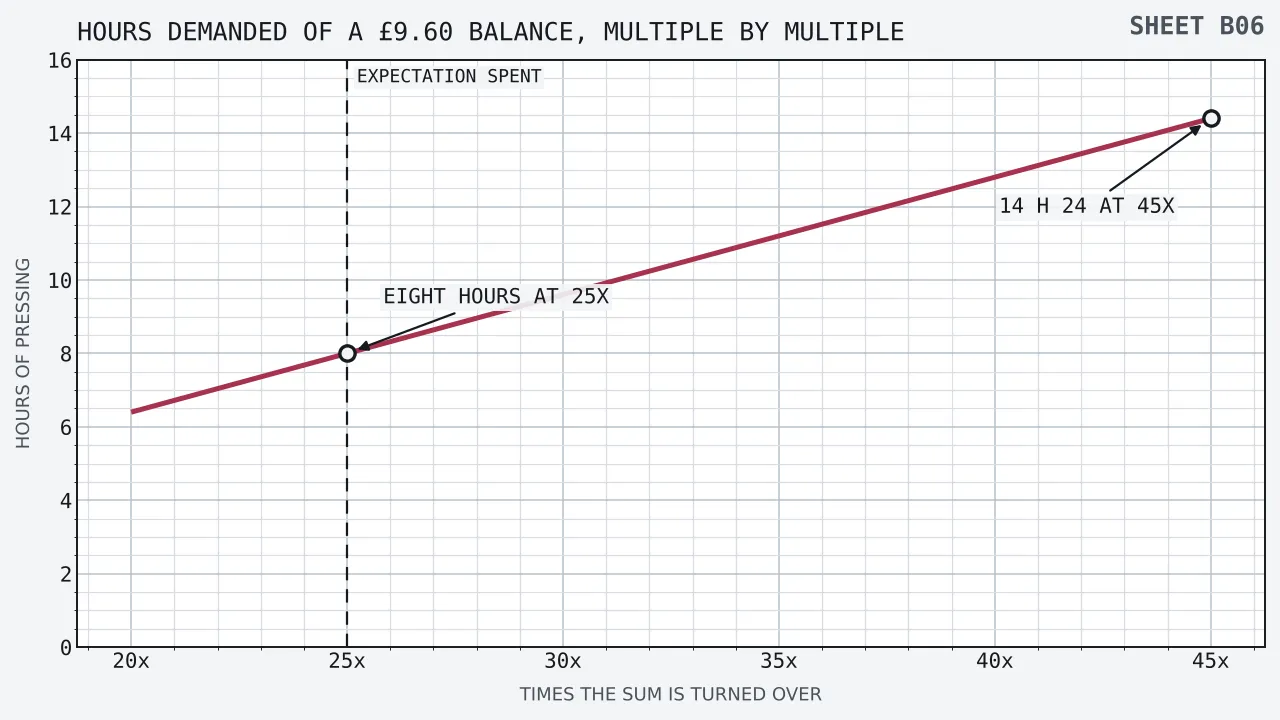
| Multiple | Turnover | Presses | Run | Sittings | Expected at the foot |
|---|---|---|---|---|---|
| 20 times | £192.00 | 1,920 | 6 h 24 min | 17 | £1.92 |
| 25 times | £240.00 | 2,400 | 8 h | 22 | £0.00 |
| 30 times | £288.00 | 2,880 | 9 h 36 min | 26 | minus £1.92 |
| 35 times | £336.00 | 3,360 | 11 h 12 min | 31 | minus £3.84 |
| 40 times | £384.00 | 3,840 | 12 h 48 min | 35 | minus £5.76 |
| 45 times | £432.00 | 4,320 | 14 h 24 min | 39 | minus £7.68 |
3
The multiple where the clock stops paying
There is one multiple at which the arithmetic turns over, and it is worth knowing before any clock is started. The expected value of a balance played through is:
9.60 × (1 − 40 × 0.04) = minus 5.76
Read the line from the inside out. Four pence is what the house keeps from each pound crossed, being the complement of a ninety-six per cent return. Forty of those bites come out of a balance played forty times. Forty fours are 160, so 1.60 of every pound is taken, which is more pound than there is, and the bracket turns negative.
Divide one by the four-pence bite and the answer is 25. That is the hinge: a play-through under twenty-five leaves something standing at the foot of the run, twenty-five exactly leaves nothing, and anything over it eats the balance before the condition can be met. Forty, the band assumed here where a sheet prints none, is well past it. For this page’s £9.60 the position at the foot works out at minus £5.76, and the thirteen hours buy the journey to that number.
An expectation is not a forecast of anybody’s evening. The spread on this kind of play is wide, and a share of readers will finish the condition and collect. The number earns its place for the opposite reason: averaged over everyone who starts, it is what the offer hands back, and an average is the only footing offers of this kind can be weighed on. An offer at this count printing a multiple of twenty-five or under is the thing genuinely worth spotting. Few do.
One more wrinkle belongs here, because it moves the hinge. Where a sheet prints a contribution rate under 100 per cent for the titles a reader is allowed to use, the turnover climbs by the reciprocal of that rate. At half contribution the £384.00 becomes £768.00, the presses double to 7,680, and the run reaches 25 h 36 min. A rate buried three screens into a term sheet can therefore cost more hours than the headline multiple does, and it is printed nowhere near it.
4
Why the run cannot be shortened by staking more
The obvious answer to a thirteen-hour run is to press fewer, larger buttons. Five hundred presses at £1.00 clears £384.00 in under two hours rather than thirteen, and a reader who has read the arithmetic this far will think of it immediately.
That door is shut, and shut deliberately. Almost every sheet of this kind sets a ceiling on what may be staked for as long as bonus money is in the account, usually near £5.00 in a desktop lobby and tighter on a handset. Nobody treats it as advice. Going over it voids more balances than any other breach, and the voiding is applied looking backwards, so finishing the whole run is no protection against being told afterwards that none of it counted.
| Stake a press | Presses | Run |
|---|---|---|
| 10p | 3,840 | 12 h 48 min |
| 20p | 1,920 | 6 h 24 min |
| 50p | 768 | 2 h 34 min |
| £1.00 | 384 | 1 h 17 min |
Raising the stake shortens the clock in exact proportion and changes the expected value not at all: the bracket in the formula holds no stake term. What it does change is the spread. A balance of £9.60 played out in 384 presses at £1.00 will more often end at nothing well before the condition is met, because there is less room for a run of ordinary results to carry it. The shorter clock is bought with a wider swing, and the term sheet caps how far that trade can be pushed.
There is a second, quieter ceiling on the same page of most term sheets: a cap on what the balance is allowed to win at all, often around £100.00 on a spin package. A reader who does clear the run meets it at the end rather than the beginning.
The cap deserves a figure of its own, because it changes what the hours are being spent on. Thirteen hours chasing an uncapped balance is one proposition. Thirteen hours chasing a balance that cannot exceed £100.00, however the reels fall, is a different one: the best outcome is fixed before the first press, and it works out at about £7.60 an hour of attention in the single luckiest case the terms permit. Every other case pays less, and the expected case pays nothing at all.
Set beside that, the twenty minutes the spins themselves take look like the only part of the offer priced sensibly. They cost nothing, they are over inside one sitting, and whatever they build is real until the conditions are applied to it. The whole of the cost in this kind of offer sits in the part that comes after.
5
When the window closes before the run ends
Every offer of this kind carries a window, and the window is the condition that most often decides the outcome. Spins commonly expire in twenty-four hours. The balance they build commonly expires in seven days. Both clocks run whether or not the reader opens the lobby.
Set those windows against the thirteen hours. Spread over seven days it comes to an hour and fifty-three minutes daily, with no day skipped. Squeeze it into seventy-two hours and the daily figure is four hours sixteen. Inside a single day it is simply not reachable by anyone who also sleeps.
| Window on the balance | Hours a day needed | Sittings a day | Reachable |
|---|---|---|---|
| 24 hours | 12 h 48 min | 35 | Not by anyone keeping ordinary hours |
| 72 hours | 4 h 16 min | 12 | Only by clearing an evening every night |
| 7 days | 1 h 50 min | 5 | Yes, without a day missed |
| 30 days | 26 min | 2 | Yes, comfortably |
What the window does at its end is the part to read before starting. On most term sheets the balance and everything built on it are removed when the clock runs out, whether the run was nine-tenths finished or untouched. Part-completed play-through earns nothing. That is the clearest sense in which these offers are priced in time rather than in money: the asset a reader puts in is hours, and an expired window writes all of them off at once.
6
What happens if you press faster than this page assumes
Every duration here hangs off one number: twelve seconds a press. It is worth being blunt about how much weight that number carries, because a reader who presses at a different rate should be able to redo the whole page in their head.
The relationship is a straight one. Halve the seconds and you halve the hours. A reader tapping at six seconds, which is brisk but not unusual on a title with the animations turned off, finishes the same 3,840 presses in six hours twenty-four rather than twelve forty-eight. A reader who drifts, reads messages between presses and leaves the lobby open, is nearer twenty seconds and spends twenty-one hours twenty.
| Seconds a press | Presses an hour | Run on 3,840 | Sittings | What it describes |
|---|---|---|---|---|
| 2.5 | 1,440 | 2 h 40 min | 8 | The regulated floor, which nobody sustains by hand |
| 6 | 600 | 6 h 24 min | 18 | Brisk, animations off, full attention |
| 12 | 300 | 12 h 48 min | 35 | The pace assumed on this site |
| 20 | 180 | 21 h 20 min | 59 | Distracted, lobby open alongside other things |
Two things survive every row of that table, and they are the two worth carrying away. The press count does not move: 3,840 is fixed by the multiple and the stake, and no amount of speed changes it. Nor does the expected value: minus £5.76 at forty times is a property of the arithmetic, not of the evening. Pace decides only how long a reader spends arriving at a figure that was settled before they started.
There is one practical consequence. Because the fastest honest pace still leaves nearly three hours on the clock, a window measured in hours rather than days is unreachable at any speed a person can keep up. That is the test to apply to a twenty-four hour window before accepting it: not whether it is tight, but whether it is possible at all.
7
The wait that starts after the last press
Finishing the run is not the same as holding the money. Press the withdraw button and two more clocks start, neither of them yours to wind.
The first is verification. On an offshore cashier this is frequently the first time documents are asked for at all, which is why a reader can play for a week before anyone wants to know who they are. Identity, address and a payment instrument are the usual three, and each round of a rejected document adds a day or more.
The second is the payout band itself, which the cashier publishes and which this site prints as it stands rather than timing anything of its own. Bands of up to forty-eight hours after approval are common, and the phrase to read closely is after approval: the band begins when the cashier finishes looking, not when the reader presses the button.
| Stage | Usual range |
|---|---|
| Documents requested and sent | Same day to two days |
| Approval | 24 to 72 hours, longer at a weekend |
| Payout band after approval | Up to 48 hours |
| The rail itself | Minutes on a wallet, up to five working days on a card |
Added to the run, a reader who starts on a Monday and plays two hours an evening is realistically looking at the second week before the money is in an account, on an offer whose banner said one hundred free spins.
8
The clocks a British licence runs
A licensed operator in Great Britain has clocks imposed on it that an offshore cashier sets for itself, and on a page about duration that is the sharpest form the comparison takes.
Take the pace first. Standard 14D in the remote technical series puts two and a half seconds between one slot cycle and the next at the quickest, flooring how fast a lobby may be driven. Work the floor through: a thousand presses at it comes to forty-two minutes, against the three hours twenty the same thousand take at the twelve seconds modelled here. So the rule is not what makes an evening long. Its job is to stop a lobby shrinking a thirteen-hour run into an afternoon by spinning faster. A sister rule, 14G, puts the gap at five seconds where the game is not a slot, leaving poker played between customers out of it, and the Commission’s page on the changes dates it to 17 January 2025.
Complaining is on a clock as well. Six months after whatever went wrong, a customer of a licensed operator may still raise it, and once the operator’s own procedure runs out there has to be an approved adjudicator to go to, free. Neither duty crosses the water with an offer run off the register. Finish thirteen hours, hear that the balance was void, and on the offshore side the route onwards is whichever one the cashier has chosen to put on its own website.
Remote licensees here have been bound to Gamstop Online since March 2020. A reader registers once, and it then stands wherever a British licence is held. Getting past it is not something this page helps with, nor does any other page here, and the same refusal covers a block set by a bank and a restriction set by a network.
9
Who should put the phone down
The arithmetic sorts readers into two groups fairly cleanly, and it is worth being plain about which is which.
An offer of this shape makes sense for someone who was going to play for several evenings anyway, who enjoys the pressing itself rather than the outcome, and for whom thirteen hours of small sessions is not a cost because it is what they were doing regardless. For that reader the hundred spins are a discount on an activity already chosen.
It makes no sense for someone treating the balance as a sum to be extracted. Thirteen hours at the national minimum wage is a figure most readers can work out for themselves, and it is several times the £9.60 being chased, before the expected value of the run is applied at all. Anyone whose plan is to clear the condition and withdraw is working for less than nothing, with a negative expectation on top.
Three figures decide it, and all three can be read off a term sheet in under a minute. The multiple, because twenty-five is the line between a run worth finishing and one that is not. The window, because an hour-count that cannot fit inside it is not a tight offer but an impossible one. The stake ceiling, because it fixes how far the clock can be compressed. A reader who checks those three before pressing anything has done the whole of the work this page does.
The honest summary is that a hundred free spins is a reasonable way to spend twenty minutes and a poor way to spend thirteen hours, and the banner only mentions the twenty minutes.
Questions
- How long does it actually take to clear 100 free spins with no deposit?
- Forty times the £9.60 those spins are expected to build comes to £384.00 that must cross the reels. Divided by a 10p press that is 3,840 presses, and at twelve seconds each that is twelve hours forty-eight minutes. The hundred spins themselves add twenty minutes, so the whole thing asks thirteen hours and eight minutes. That pace is assumed here, not measured.
- Why is twenty-five times the multiple that matters?
- Divide one by the four-pence bite the house keeps out of each pound and 25 falls out; the bite is four because ninety-six of those pence go back. Under 25 a balance still has something standing when the run ends, at 25 it has nothing, and over 25 the run swallows it before the condition is satisfied. Forty is a long way over.
- Can I finish faster by staking more than 10p a press?
- Only within the maximum stake the term sheet allows while bonus funds are live, which is commonly around £5.00 and often lower on a handset. Raising the stake shortens the run in exact proportion and leaves the expected value unchanged, but it widens the swing, so a balance is more likely to reach nothing before the condition is satisfied. Breaching the ceiling is the most common reason a balance is voided after the fact.
- What happens if the window closes before I finish the play-through?
- On most term sheets the balance and everything built on it are removed when the clock runs out, whether the run was nearly finished or barely started. Part-completed play-through earns nothing. A seven-day window against a thirteen-hour run means one hour fifty-three minutes every day without a day missed.
- How long after the last press does the money arrive?
- Two clocks start when a withdrawal is asked for. Verification is often the first time documents are requested at all and takes a day or more per round. The payout band then runs from approval rather than from the request, and bands of up to forty-eight hours after approval are common. The rail itself adds minutes on a wallet or up to five working days on a card.
- Do these offers hold a Great Britain licence?
- An offer shaped like this one sits outside the British register. Gone with the licence are the register entry, the ceilings on stake and deposit, Gamstop Online, the tax position, and a regulator under a duty to answer. Where the question is time, the complaint clock is the sharpest loss: six months after an incident a customer of a licensed operator may still raise it, and an approved adjudicator has to be available free once the operator’s own procedure runs out.
- Does the 2.5 second rule make the run shorter?
- No. Standard 14D in the remote technical series puts two and a half seconds between one slot cycle and the next at the quickest, which floors the pace rather than capping the session. Worked through, a thousand presses at that floor is forty-two minutes, against three hours twenty for the same thousand at the twelve seconds modelled here. The rule is there to stop a lobby compressing a run, not to shorten one.
- Is a hundred free spins worth taking at all?
- It is reasonable for someone who was going to play several evenings anyway and enjoys the pressing itself, because the spins are then a discount on an activity already chosen. It is poor value for anyone treating the balance as a sum to extract: thirteen hours of attention for a £9.60 balance carrying a negative expectation at forty times is working for less than nothing.